If your cat tracks litter across the floor after every bathroom visit — and nearly all cats do — a litter mat is the rectangular pad you place directly in front of the litter box to catch stray granules before they migrate to your sofa or your bare feet. The mat works in two ways: its surface texture grabs litter from your cat’s paws as she steps off, and (ideally) a waterproof backing keeps any tracked-in moisture or near-misses from soaking into your floor. Sounds simple. The problem is that most mats look perfectly adequate on the product page and fall apart — literally or functionally — after six to ten wash cycles. This guide is for owners who have already been burned by a mat that curled, de-laminated, or lost its trap texture after a month of washing, and want a clear framework for buying better.
| EDITOR'S PICK[Lovewag Pets Cat Litter Mat 2 P…](https://www.amazon.com/dp/B0CWLSP9TP?tag=greenflower20-20) | Mid-tier[CatGuru Cat Litter Mat](https://www.amazon.com/dp/B06ZZ9XMZF?tag=greenflower20-20) | Budget pick[Pieviev Cat Litter Mat Double L…](https://www.amazon.com/dp/B07NJ5SR5G?tag=greenflower20-20) | |
|---|---|---|---|
| Dimensions | 36x48 in | — | 24x15 in |
| Pack count | 2 | — | 1 |
| Machine washable | ✓ | ✓ | — |
| Non-slip | ✓ | ✓ | — |
| Material | — | — | Double layer |
| Price | $29.99 | $22.99 | $11.27 |
| See on Amazon → | See on Amazon → | See on Amazon → |
The Three Properties That Actually Determine Longevity
You can organize every litter mat on the market around three variables. Understanding which one matters most for your situation is the fastest way to narrow the field.
1. Trapping Architecture
“Trapping” refers to how the mat physically captures litter. Two dominant designs exist.
Honeycomb or grid-hole mats (often EVA foam or rubber) use raised cells with open pockets beneath. Litter falls through the top layer and sits below the surface grid, out of reach of paws re-tracking it. Wirecutter (The New York Times), in their guide titled “The Best Cat Litter Mat,” notes that large-hole grid designs tend to outperform flat-pile textiles for granular containment, particularly with larger-particle clay or crystal litters. The tradeoff: the pockets can be awkward to empty cleanly, and grid mats have a utilitarian look that can conflict with styled interiors.
Microfiber or chenille-pile mats rely on dense fabric loops to grab and hold litter mechanically, the same way a bath mat traps water droplets. These tend to photograph better, integrate more naturally into a bathroom or laundry room, and trap finer-particle litters — pine crumble, wheat, fine silica — more effectively than grid holes. Their weakness is washability: every time the pile is agitated in a machine, litter trapped in the fibers gets redistributed through the wash load, the fibers gradually compress, and trap efficiency drops.
The practitioner tradeoff: If you are washing the mat more than twice a month — common in multi-cat households or with high-scatter litter types — a grid or honeycomb design preserves trap performance longer because its geometry does not degrade with washing the way pile fabric does. If you wash less frequently and prioritize aesthetics, a quality microfiber mat in the $35–$65 range is the better fit.
2. Waterproofing Construction
Waterproofing in litter mats comes in three tiers, and the label “waterproof” on a product page does not reliably tell you which tier you are getting.
TPR or rubber backing only — The most common entry-level construction. A thin thermoplastic rubber layer on the underside resists surface moisture but is not a sealed membrane. Repeated washing, especially in hot water, causes micro-cracking in cheaper TPR compounds. Apartment Therapy’s editorial piece “The Best Cat Litter Mats to Keep Your Home Clean” identifies backing peel and crumble between wash cycles six and twelve as the single most common long-term complaint across the litter mat category — a pattern consistent with owner-reported experiences the editors aggregated in their testing process.
Laminated waterproof layer (PVC or TPU film) — A bonded film layer between the top fabric and the rubber base. This construction is more durable under repeated washing because the waterproof membrane is structural rather than surface-applied. TPU (thermoplastic polyurethane) is the more premium version: it remains flexible after repeated thermal cycling, while PVC can stiffen and crack in cold-water wash environments. Manufacturer spec sheets at this tier typically note “machine washable, cold, gentle cycle” — the cold-water caveat is meaningful, not boilerplate.
Fully integrated rubber or EVA construction — Grid mats made from a single molded material have no laminate to delaminate and no pile to compress, making them intrinsically waterproof by design. Consumer Reports, in their pet product buying guide coverage, consistently rates single-material construction as the most wash-durable format in floor mat categories generally. The limitation is that EVA and rubber hold odor more readily than fabric if not dried thoroughly between uses.
3. Dimensional Stability After Washing
Curling is the single most-reported failure mode in litter mat reviews across every price tier. A mat that curls at the corners after washing creates a trip hazard and allows litter to channel underneath rather than stay contained. Three factors drive curling.
Asymmetric construction: A thick fabric top paired with a thin rubber bottom will curl toward the rubber after thermal cycling because the materials contract at different rates. Quality mats use a balanced construction — comparable material weight on both faces — or a thick-enough base layer to resist the differential.
Wash temperature: Hot water accelerates delamination and differential contraction. Nearly every mat that survives long-term in owner-reported testing is washed cold on a gentle cycle and air-dried flat or tumbled on low heat.
Mat size relative to the drum: Oversized mats folded into a standard residential washer develop permanent creases along the fold. PetMD’s editorial article “How to Keep Your Home Clean With a Cat” recommends sizing any washable mat to fit your drum without folding — practically, this means confirming that anything over 30 × 24 inches fits your machine’s capacity before buying.
Comparing Mat Types: Which Tier Fits Your Household
Budget-Tier: Grid and Honeycomb Mats
Grid mats molded from EVA foam or basic rubber represent the most economical entry point, typically ranging from $15 to $40. Their single-material construction means there is no laminate layer to peel and no pile to compress — the trapping geometry either works or it does not, and washing does not change that geometry. Wirecutter’s “The Best Cat Litter Mat” testing found that large-hole grid designs provided stable granular containment even after extended use, making them particularly well suited to multi-cat households where washing frequency is high.
The honest limitations at this tier are aesthetic and olfactory. The molded grid look reads as utility equipment rather than a considered home accessory, and EVA foam can retain odor if the mat is stacked or stored damp. For households where the litter box lives in a utility room, basement, or closet alcove — out of general sightlines — these limitations are largely irrelevant.
Best for: Multi-cat households, high-frequency washing (weekly or biweekly), clay or crystal litter types, utility or non-visible placements.
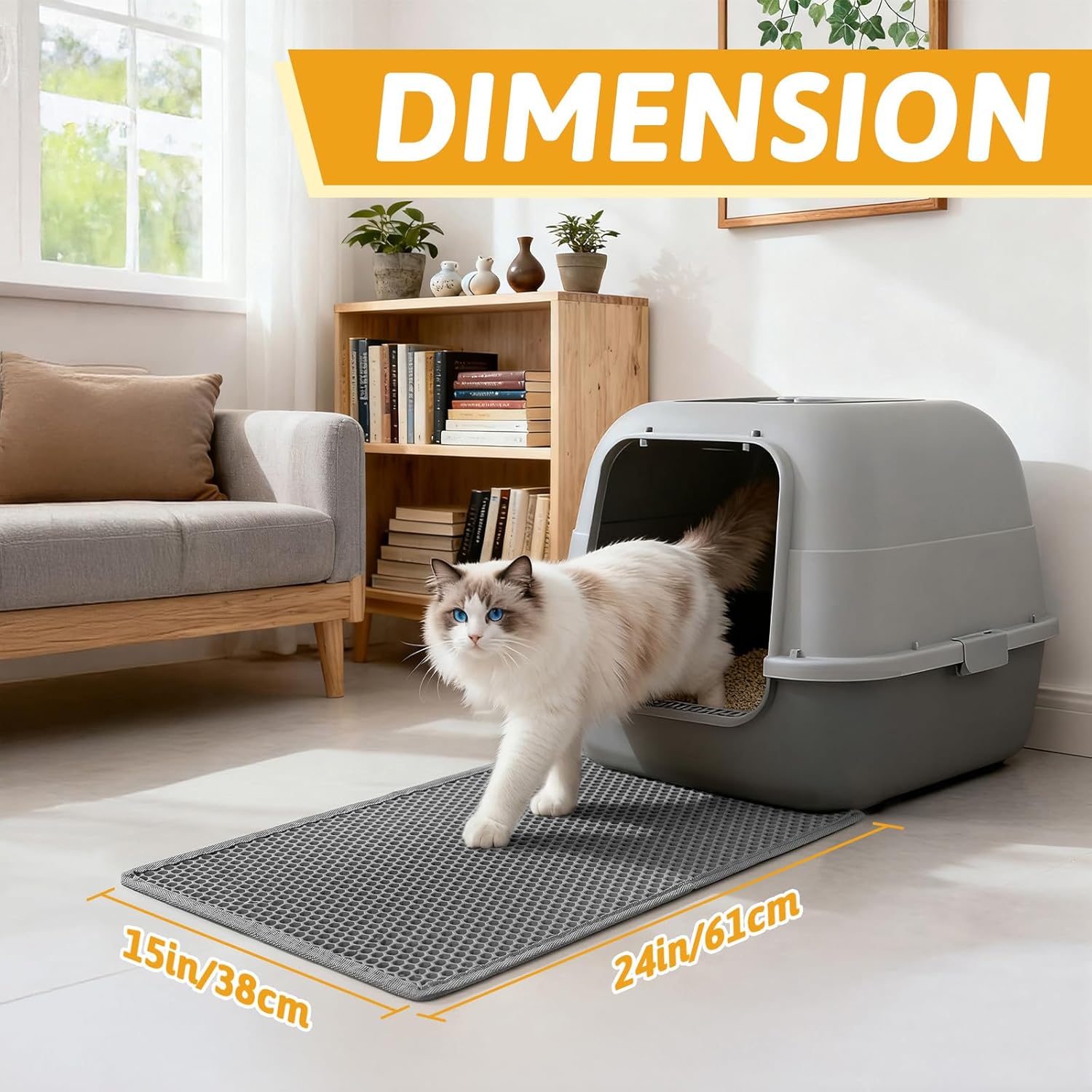
Pieviev
$11.27
In stock on Amazon
Check price on AmazonMid-Tier: Pile Fabric Mats with TPU Laminate Backing
The mid-tier bracket, roughly $40 to $75, is where fabric-surface mats with a bonded TPU waterproof layer live. This construction gives you the aesthetic softness of a chenille or microfiber surface — better integration into a styled bathroom or laundry room — while the TPU film beneath provides a structurally sound moisture barrier that holds up through cold-water, gentle-cycle washing better than basic TPR backing.
Apartment Therapy’s litter mat editorial highlights fabric-surface mats with a non-slip waterproof backing as the winning format for visible, styled spaces precisely because they can read as a considered bathroom accessory rather than utility equipment. International Cat Care (iCatCare), in their guidance document “The Five Pillars of a Healthy Feline Environment,” emphasizes that predictable, easy-to-maintain litter surrounds benefit the cat’s hygiene habits by encouraging owners to keep the area consistently clean — a well-designed mat that owners actually want to maintain serves that goal.
The tradeoff at this tier is pile compression over time. Dense chenille loops trap fine-particle litters effectively when the mat is new, but repeated machine washing gradually compresses the pile and reduces trap depth. Owners who follow the cold-wash, air-dry-flat protocol and wash no more than twice monthly report significantly longer pile integrity — in some cases past the twelve-month mark. Budget for replacement annually rather than semiannually, and that cost remains reasonable.
Best for: Single- or dual-cat households, monthly or bimonthly washing, fine-particle litters (pine, wheat, fine silica), visible or styled placements.
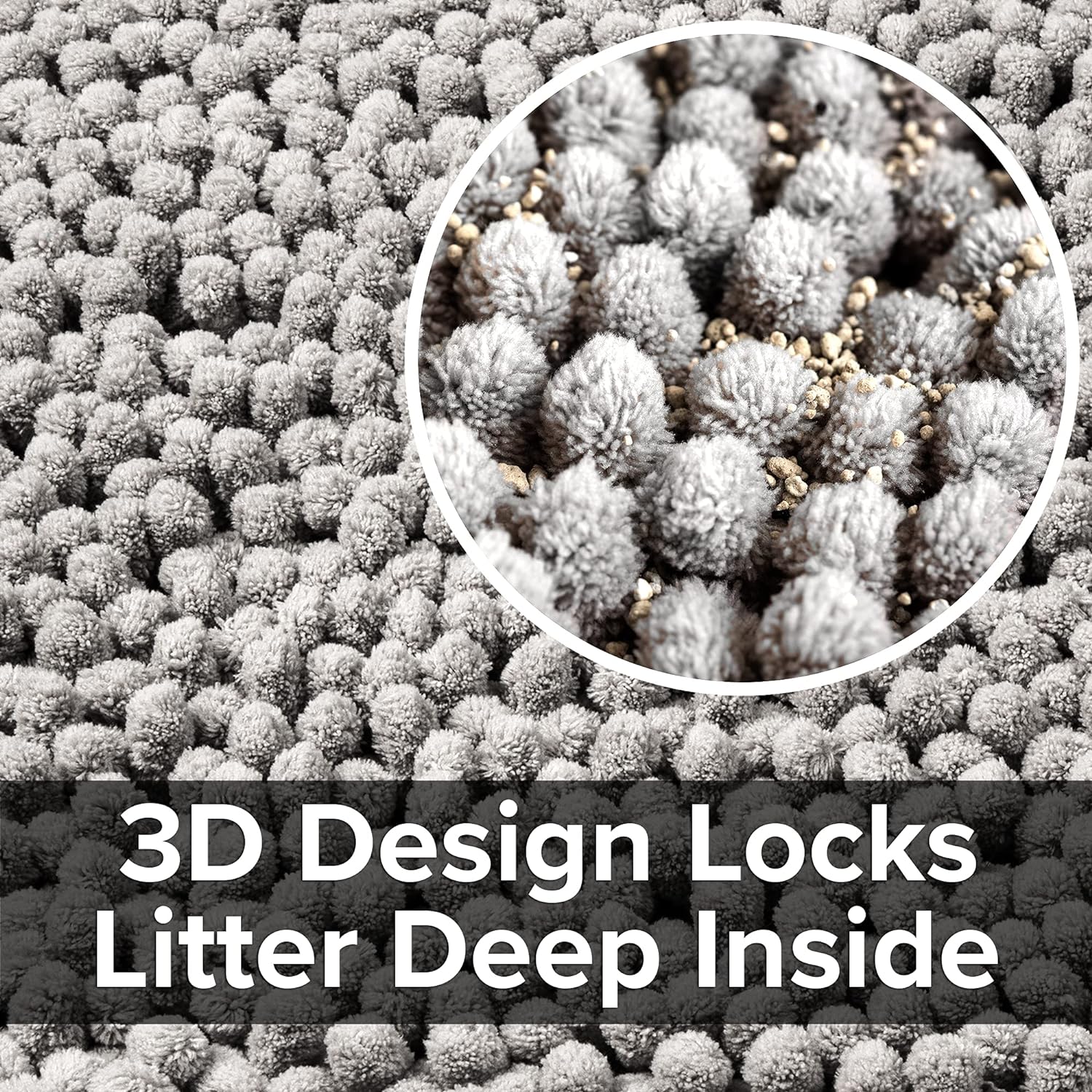
CatGuru
$22.99
In stock on Amazon
Check price on AmazonPremium Tier: Natural Rubber and Molded Rubber Mats
The premium tier, from roughly $55 to $120, covers mats constructed from natural rubber or high-grade molded synthetic rubber with meaningful thickness — typically 5mm or more. These mats share the single-material durability advantage of budget grid mats but add substantially better dimensional stability (thick rubber resists curl even through aggressive wash cycles), better anti-slip performance on hard floors, and, in better-designed products, surface textures that trap litter without the clinical grid aesthetic.
Consumer Reports’ pet product buying guide coverage of floor mat categories identifies single-material rubber construction as the highest-durability format and notes that premium rubber mats from established brands frequently carry one- to two-year manufacturer guarantees against delamination — a warranty that functions as a proxy for construction quality rather than merely customer service signaling. Consumer Reports also emphasizes a consistent principle applicable here: material specifications on a product page should be specific (natural rubber, TPU film, EVA foam) — vague language like “premium material” or “heavy-duty backing” without material identification is marketing language, not construction data.
The cost-per-use math at this tier rewards high-frequency households. A $70 rubber mat that owners consistently report using for two or more years without performance loss runs approximately $35 per year. A $45 microfiber mat that degrades meaningfully within six months of twice-monthly washing runs $90 per year. For three-or-more-cat households committed to the grid format, the premium rubber tier is the economically rational choice at scale.
Best for: Multi-cat households willing to invest upfront, owners who prioritize long-term economy, households using clay or crystal litter where grid trapping performs well.
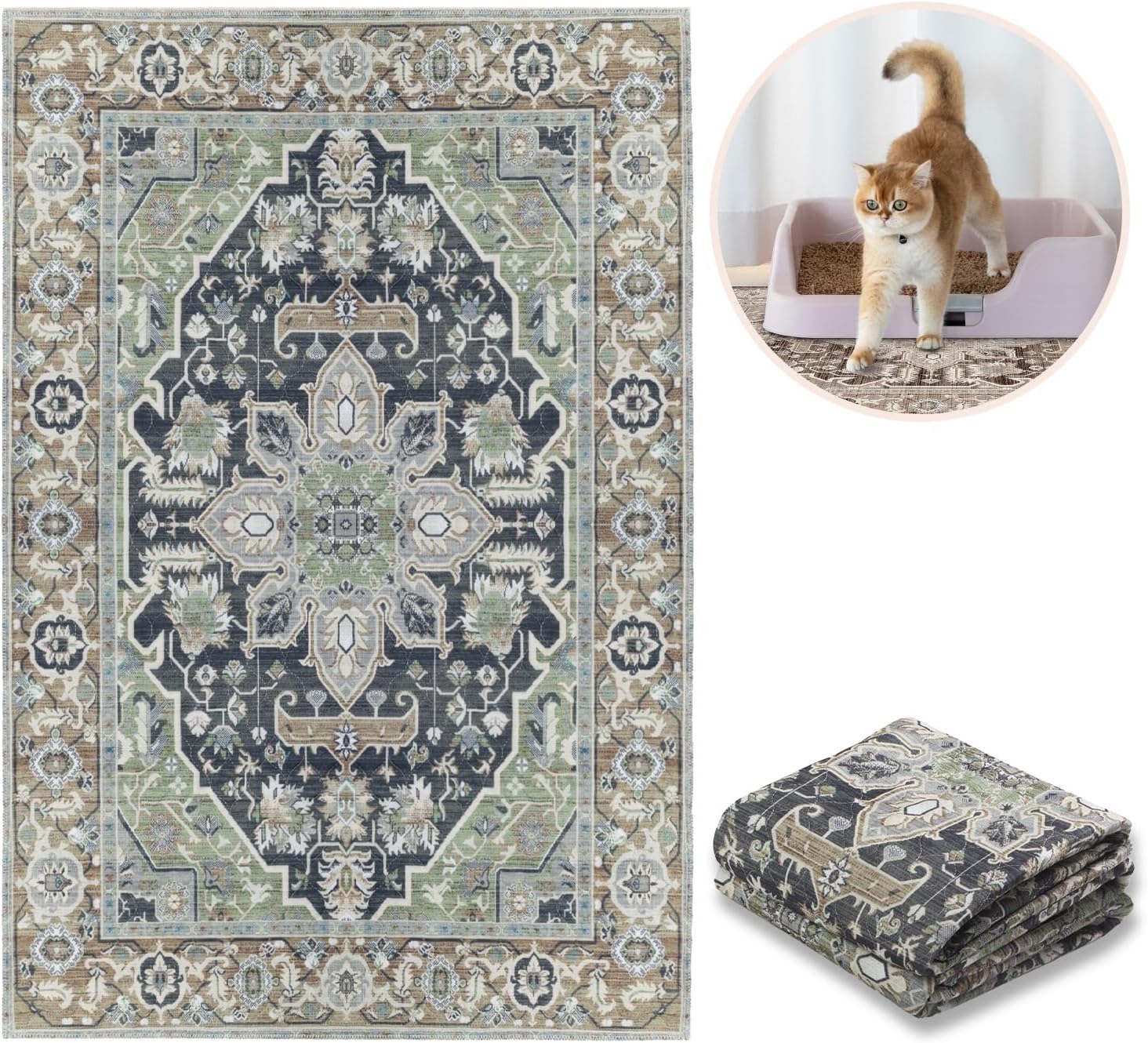
Lovewag
$29.99
In stock on Amazon
Check price on AmazonWhat to Verify Before You Buy
A few questions that change the answer quickly, regardless of tier.
What is the advertised waterproofing construction — backing, laminate, or single material? If the product page does not specify, that is usually a signal that it is basic TPR backing only. PetMD’s household hygiene guidance for cat owners notes that vague product descriptions consistently correlate with the entry-level construction tier.
What wash temperature and cycle does the manufacturer specify? “Machine washable” without a temperature rating is a meaningful red flag. Legitimate waterproof laminate construction will specify cold water on a gentle cycle — that caveat reflects the thermal tolerance limits of the waterproof layer, not a conservative suggestion.
What are the mat’s dimensions, and will they fit your washer drum flat? Your washer’s capacity is listed in cubic feet on the manufacturer spec sheet or inside the door panel. Confirming this before ordering an oversized mat eliminates the most common curling complaint reported across all price tiers.
Does the product carry a warranty or explicit durability claim? As Consumer Reports notes in their pet product guidance, a named guarantee against delamination from an established brand is a more reliable signal of construction quality than any marketing descriptor.
The right litter mat is a genuine quality-of-life upgrade — for you and for maintaining the clean box environment your cat needs. But it is also one of the most over-marketed, under-engineered product categories in the pet space. Match the trapping architecture to your litter type, match the waterproofing tier to your wash frequency, verify the construction claims before purchase rather than after the fourth wash cycle, and use the tier framework above to set a realistic replacement budget. The mat that survives is rarely the cheapest or the most expensive — it is the one whose construction matches how your household actually uses it.