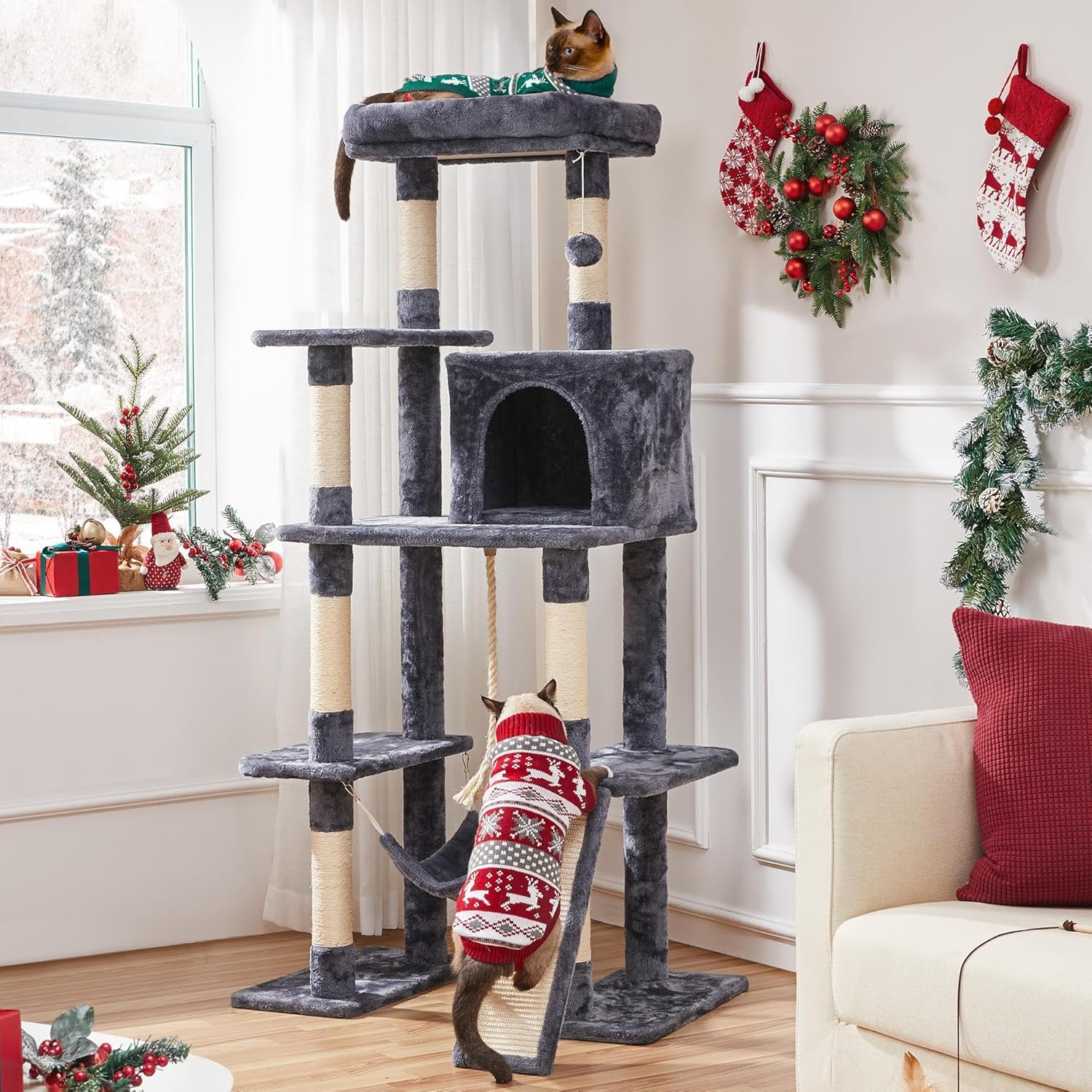
A cat tree is exactly what it sounds like: a freestanding tower — usually wrapped in sisal rope or carpet — that gives cats places to climb, scratch, perch, and nap above floor level. For most cats, this is enrichment; for large breeds like Maine Coons, Ragdolls, Norwegian Forest Cats, and Savannahs, it’s closer to a structural engineering challenge. These cats regularly hit 15–25 pounds, launch off platforms at full speed, and will expose every weakness in a wobble-prone tower within the first week. If you’ve already burned through one “heavy duty” tree that swayed, tipped, or shed its platform bolts, you already know the problem. This guide breaks down what stability actually comes from — base geometry, post diameter, ballast design, and hardware quality — so you can evaluate the next purchase with a concrete checklist rather than a leap of faith.
Why “Heavy Duty” Is Usually a Marketing Label, Not a Spec
Search any major retailer for “heavy duty cat tree” and you’ll find the phrase applied to products rated for 15 pounds and products rated for 60 pounds. The label has no standardized definition. No independent third-party body currently certifies cat furniture for load capacity the way, say, ANSI certifies ladders or BIFMA certifies office chairs. That matters because it shifts the entire burden of evaluation onto you, the buyer.
What manufacturers are actually telling you when they say “heavy duty” usually resolves to one or more of these claims:
- Platform weight rating — the static load a single perch is engineered to hold (often 25–35 lbs on mid-range trees, 40–60 lbs on purpose-built large-cat models)
- Total system weight rating — a less commonly stated figure representing the combined dynamic load the whole structure handles before the base deforms or tips
- Post diameter — thicker posts (typically 4–6 inches diameter on serious large-cat trees vs. 3–3.5 inches on standard models) reduce lateral flex when a cat launches or lands
- Base footprint — the single most predictive variable for tip resistance, and the one most often obscured in product listings
Here’s the problem: a tree can have a 50-lb platform rating and still tip catastrophically if the base footprint is too narrow for the height. Stability is a ratio problem, not just a weight problem.
The Height-to-Base Ratio: The Number Every Listing Buries
Structural engineers use a center-of-gravity principle that applies directly here: the taller the structure, the wider the base needs to be to resist lateral tipping forces. For cat trees specifically, owners and reviewers across aggregated long-run reviews consistently identify a base footprint under roughly 18 × 18 inches as a tipping risk on any tower exceeding 60 inches — regardless of platform weight rating.
By the numbers:
| Tree Height | Minimum Recommended Base | Risk if Undersized |
|---|---|---|
| Under 48 in. | 16 × 16 in. | Low–moderate |
| 48–66 in. | 18 × 20 in. | Moderate if cat > 15 lbs |
| 66–80 in. | 20 × 24 in. | High without wall anchor |
| 80 in.+ | Wall anchor required | Tip risk regardless of base |
Modern Cat’s buying guidance notes that for cats over 15 pounds, owners should treat any tree taller than 5 feet as requiring either a genuinely wide base or a wall-anchor kit — not as an optional accessory but as a safety component.
Reading the Actual Specs: A Practical Checklist
When you’re evaluating a listing — whether you’re comparing mid-range options around $120–$180 or premium solid-wood builds at $400–$600 — these are the numbers to extract before anything else.
1. Platform Weight Rating vs. System Rating
Most listings publish only platform rating. This tells you whether your 20-lb Maine Coon will physically fit on a perch without breaking it — useful, but incomplete. What it doesn’t tell you is what happens when that same cat hits the platform at speed after a running jump from the floor. Dynamic load (impact + momentum) during a cat’s landing can multiply effective force by 2–3× the cat’s static weight, per basic physics principles that structural analysts at Modern Cat and PetMD’s behavioral coverage both reference when discussing why active climbers stress furniture differently than cats who simply rest.
Ask yourself: does the manufacturer publish a system or total weight rating anywhere, not just per-platform? If not, the post diameter and base footprint become your proxies.
2. Post Diameter and Core Material
This is where the gap between budget and premium trees is most honest. A 3-inch nominal post wrapped in sisal can look nearly identical to a 5-inch solid post from a distance. The difference shows up in lateral flex — the side-to-side sway when a cat jumps onto a high perch.
- Standard posts (2.75–3.5 in. diameter): Adequate for cats under 12 lbs on trees under 5 feet
- Mid-range posts (4–4.5 in.): Handles most cats up to ~18 lbs on trees 5–6 feet with a proper base
- Heavy-duty posts (5–6 in.): The specification to look for in large-cat-targeted products; owners of Maine Coons and Savannahs consistently report that this is the threshold where wobble disappears
Core material matters as much as diameter. Engineered particleboard cores compress and deform over time, especially where bolts connect platforms to posts. Solid wood cores (sometimes seen in premium builds from brands targeting the design-forward segment) or thick-wall MDF with metal hardware inserts hold torque far longer. Apartment Therapy’s roundup of design-forward cat trees notes that the longevity gap between particleboard and solid-substrate builds becomes obvious around the 18-month mark, when budget trees start showing platform tilt and joint wobble.
3. Base Construction: Ballast vs. Footprint
Two valid engineering strategies exist, and neither is universally superior:
Wide, flat base: Maximum footprint, distributed weight. Best for open-floor placement away from walls. The trade-off is floor space and visual bulk. For households with design priorities — mid-century, Scandinavian, or contemporary interiors — a large carpet-covered base platform can feel ungainly.
Weighted/ballast base: A smaller footprint base that achieves stability through mass rather than spread. Less common in cat furniture than in standing lamps or speaker stands, but increasingly seen in premium-tier designs using solid walnut or powder-coated steel ballast slabs. This approach allows a narrower visual footprint while maintaining tip resistance, which is why design-savvy brands favor it. The trade-off: if the ballast material is hollow or uses low-density fill, the approach fails on paper while looking like it shouldn’t.
When a listing describes a “weighted base,” ask whether the weight is published. A base slab needs to be meaningfully heavy — owners in long-run reviews of premium modular systems report that bases under roughly 8–10 lbs provide negligible ballast benefit over a standard flat platform of equivalent footprint.
4. Hardware: The Failure Point No One Photographs
The bolts, cam locks, and barrel nuts connecting posts to platforms are where budget trees fail first. Signs of quality hardware in a listing:
- Metal-threaded inserts embedded in the post (not just wood screws threading into particleboard)
- Published bolt diameter (M6 or larger is a reasonable baseline for large-cat loads)
- Re-tightening instructions in the manual — a brand that acknowledges hardware can loosen over time is being honest about physics; one that doesn’t mention it is hoping you won’t notice
Cornell’s Feline Health Center’s environmental enrichment guidance emphasizes that cats rely on vertical structures for stress regulation, territory signaling, and exercise — meaning a wobbly or unstable tree doesn’t just create a physical hazard, it undermines the behavioral function the product is supposed to serve. A tree a large cat doesn’t trust will simply be avoided.
The Wall-Anchor Question
For any tree over 66 inches with a cat over 15 pounds, the wall-anchor decision isn’t really optional — it’s a question of whether the anchor is included, easy to install, and strong enough.
Owners consistently report two failure modes here:
- Anchor kit included but inadequate — thin L-brackets rated for picture-frame loads, not dynamic cat impact. Check whether the kit includes drywall anchors rated for the product’s stated system weight, or whether it’s expecting a stud connection.
- No anchor at all — common on trees that market to apartment dwellers and appear to be trying to avoid the question. If the listing doesn’t address anchoring for tall configurations, that’s an editorial gap, not a feature.
International Cat Care’s guidance on environmental needs specifically highlights vertical space as a welfare essential for indoor cats — but adds that any climbing structure must be stable enough that a cat can use it confidently without fear of sudden movement. A tree that shifts or sways trains avoidance behavior into cats, especially those who’ve already had a tip-over experience.
Decision Framework: If X, Then Y
You’ve done the research. Here’s how to resolve the decision:
If your cat is under 12 lbs and the tree is under 54 inches: Standard construction with a 16 × 16 in. base and 3.5-inch posts is workable. Weight ratings above 25 lbs per platform are sufficient. Budget range ($80–$140) is appropriate.
If your cat is 12–18 lbs and the tree is 54–66 inches: You need a minimum 18 × 20 in. base, 4–4.5 in. posts, and metal-insert hardware. This is the mid-range sweet spot ($150–$250). Confirm the wall-anchor kit is included and rated correctly.
If your cat is over 18 lbs or you have multiple large cats sharing one structure: Treat anything under a 20 × 22 in. base, 5-inch posts, and published system rating as a mismatch for your use case. Budget accordingly for the $250–$450 tier, or consider a modular climbing system with a wall-mounted anchor as the primary stability mechanism rather than a floor base entirely.
If design integration matters and you’re spending $400+: The ballast-base approach from premium solid-wood or steel-frame builders is the right category. Confirm the ballast weight is published, verify the post-to-platform joint uses metal hardware inserts, and read long-run owner reviews specifically from large-cat households — the 12-month and 18-month observations are where premium trees prove or fail their construction claims.
The word “heavy duty” should trigger a reflex to look past it. Base dimensions, post diameter, hardware type, and system weight rating are the four numbers that actually answer the question. Any listing that buries or omits those specs is leaving the structural risk entirely with you.