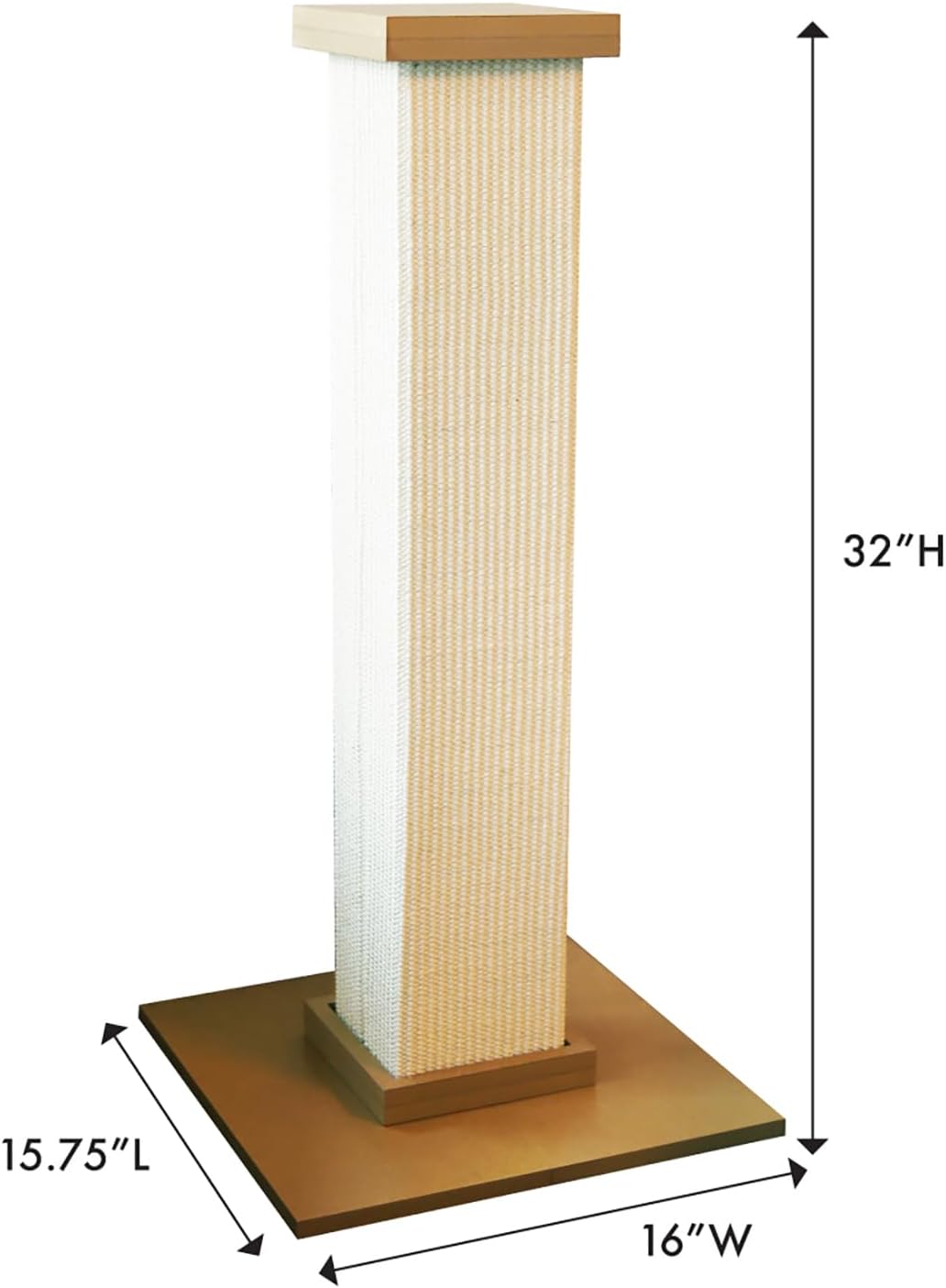
If your cat is shredding your sofa while an untouched scratching post gathers dust in the corner, you are not alone — and you are almost certainly not dealing with a stubborn cat. Scratching is a hardwired, non-negotiable behavior: cats scratch to shed the outer sheath of their claws, to stretch the long muscles along their spine, and to leave both visual and scent-based territorial signals. They are not misbehaving; they are doing exactly what their biology requires. The problem, in most households, is that the post you bought does not match what their instincts are searching for. This guide breaks down the two variables that account for most redirection failures — material (what the post is covered in) and height (how tall it stands) — and gives you a clear framework for matching post to cat before you spend another dollar.
Why Most Scratching Posts Fail Before You Even Place Them
The market is flooded with scratching posts, and the majority of them fail for predictable, avoidable reasons. International Cat Care’s behavioral guidance on scratching notes that cats show strong preferences for specific textures and orientations, and that a post which doesn’t match those preferences will simply be ignored — no matter how close to the sofa you position it.
Two failure modes dominate:
1. The wrong material. The most common post covering sold at mass-market price points is carpet — often the same looped-pile construction as household flooring. The problem is structural: looped pile compresses under claw pressure rather than shredding and separating. Cats scratch for tactile feedback, the resistance and give of fibers pulling apart under their claws. Carpet denies that feedback. Cornell Feline Health Center’s overview of destructive scratching confirms that cats prefer substrates that allow them to drag their claws through the material with real resistance — which is why sisal rope, corrugated cardboard, and raw wood remain the consistent top performers.
2. The wrong height. A cat performing a full scratch-and-stretch sequence needs to extend its body to near-full length with both forepaws overhead. For an average adult domestic cat, that means the usable scratching surface needs to reach at least 28–32 inches from the floor. Most budget posts top out at 18–22 inches — tall enough to look functional, too short to satisfy the stretch drive. The ASPCA’s behavioral guidance on scratching explicitly calls out post height as one of the primary reasons cats return to furniture: a sofa arm or door frame provides unlimited vertical real estate; a stunted post does not.
Material Breakdown: What the Research and Owner Reports Actually Show
Here is where the decision math gets specific. These are the four materials you will encounter across the $20–$200+ range, ranked by how consistently they redirect cats away from upholstered furniture.
Sisal Rope
Best overall for active scratchers. Sisal is a natural plant fiber wound tightly around a post in continuous coils. The texture is coarse and deeply satisfying to cats precisely because individual strands fray and separate under claw drag — the tactile payoff that carpet denies. Wirecutter’s regularly updated best-scratching-post guide has consistently ranked sisal-rope posts as its top pick across multiple revision cycles, citing owner-reported redirection success and durability.
The tradeoff is lifespan. Heavy scratchers will work through sisal rope in 6–18 months depending on frequency of use and post diameter. Thicker diameter sisal (posts from brands like Frisco, SmartCat, and the premium tier from Tuft + Paw) lasts meaningfully longer than thin-gauge wrapping. Look for tightly wound, continuous coils — gaps in the winding are the first place unraveling begins.
Sisal Fabric (Woven Sisal)
A step up in durability and, for design-forward households, aesthetics. Woven sisal fabric — used by brands including MiaCara and several Etsy-market custom builders — presents a flat, tightly interlocked surface rather than coiled rope. Cats scratch it effectively; it wears more evenly than rope and resists the “unspooling” failure mode. PetMD’s 2024 overview of cat scratching preferences notes that woven sisal fabric tends to show a longer usable lifespan than equivalent rope coverage on the same post form factor.
The honest caveat: woven sisal panels are harder to replace when they do wear out. Rope-wrapped posts often accept replacement wrapping kits. Fabric-panel posts typically require manufacturer replacement parts or a full-post replacement.
Corrugated Cardboard
Best for horizontal scratchers and budget households. Some cats — particularly those who scratch along baseboards, carpet edges, or the bottom of sofa legs — are horizontal or low-angle scratchers. They are not looking for vertical resistance; they want to drag claws along a flat plane. Cardboard scratchers serve this population almost perfectly. The fluted paper construction shreds in a deeply satisfying way, the price point is negligible ($10–$25 for reputable options), and replacements are guilt-free.
The limitation is that cardboard does not solve the problem for a cat whose furniture target is a sofa arm or a vertical door frame. If your cat scratches primarily vertically, a horizontal cardboard pad is a supplement, not a solution. Apartment Therapy’s 2024 guide to ignored scratching posts makes this point directly: matching the orientation of the post to the cat’s existing scratching posture is as important as material choice.
Carpet
Avoid as a primary post material. The reasons are outlined above: compressed pile denies tactile feedback, and — critically — carpet-covered posts risk training cats that carpet is an acceptable scratch surface, which is the opposite of the goal. The one narrow exception is households where the existing upholstered furniture is high-pile velvet or chenille; some owners report that a carpet-covered post provides a similar enough texture to draw interest from cats who have already bonded to that specific feel. This is a niche edge case, not a general recommendation.
Height: The Specification That Most Listings Underreport
By the numbers:
| Cat size | Recommended minimum post height | Common budget-post height | Gap |
|---|---|---|---|
| Small adult (6–8 lbs) | 28 inches | 18–22 inches | 6–10 in. short |
| Average adult (9–12 lbs) | 30–32 inches | 18–22 inches | 8–14 in. short |
| Large adult (13–18 lbs) | 34–36 inches | 18–22 inches | 12–18 in. short |
This table illustrates why the majority of budget posts are structurally inadequate for average and large cats. A Maine Coon or a large-framed domestic shorthair trying to perform a full-body stretch against a 20-inch post is biologically unsatisfied. They will return to the sofa because it solves the problem the post cannot.
The minimum height rule of thumb cited consistently across International Cat Care’s scratching behavior documentation and Cornell’s destructive scratching overview: the usable scratching surface should allow the cat to extend to full stretch with both forepaws reaching upward and still find surface to grip. Measure your cat from floor to extended-forepaw tip while they are actively stretching — this is your floor for minimum post height, not a product marketing height.
Base stability matters as much as height. A tall post on a narrow base will tip when a cat leans into it at full stretch. One tip event is often enough to permanently alienate a cat from that post. Owners consistently report that a single tipping incident produces lasting post-avoidance — the cat learned the post is unsafe. Wirecutter’s guide specifically flags base-to-height ratio as a critical spec: for posts above 30 inches, a weighted base of at least 14–16 inches square (or a wall-mount option) is recommended. SmartCat’s Ultimate Scratching Post is frequently cited in aggregated reviews for threading this needle well at its price point.
Placement Strategy: The Variable That Ties Material and Height Together
Even the right post at the right height fails if it is placed incorrectly. The ASPCA’s destructive scratching guidance is clear: scratching posts need to go where the cat already wants to scratch, not in an out-of-the-way corner that is convenient for you. That means placing the new post directly adjacent to — or overlapping with — the furniture being targeted, then gradually relocating it once the behavior redirects. Cats are territorial and location-specific; they are scratching the sofa arm, not “a vertical surface somewhere in the living room.”
A secondary placement insight from PetMD’s 2024 behavioral overview: cats often scratch immediately after waking. A post placed near a preferred sleeping location — cat bed, favorite chair corner, windowsill — intercepts the post-nap stretch before the cat reaches the sofa. This is not a trick; it is matching the post’s location to the behavior’s trigger.
The Decision Framework: If X, Then Y
If your cat scratches vertically on sofa arms, door frames, or curtains: → Buy a sisal-rope or woven-sisal post, minimum 32 inches tall, with a weighted or oversized base. Prioritize height over price. The SmartCat Ultimate Scratching Post (around $35–$45) is the analyst-consensus entry point; the Tuft + Paw Cove or MiaCara options serve the design-forward household at $150–$300+ with equivalent or superior sisal construction.
If your cat scratches horizontally along carpet edges, baseboards, or sofa bases: → Start with a corrugated cardboard horizontal scratcher ($12–$25) placed flat on the floor at the target location. Add a low-angled ramp-style sisal scratcher if flat cardboard does not fully satisfy.
If you have multiple cats (3+) or a large-framed breed: → Plan for at least one post per cat plus one additional; competition for a single post increases furniture scratching in multi-cat homes. Prioritize heavier-gauge sisal rope and reinforced bases rated for repeated heavy use. Operators in long-run multi-cat household reviews note that budget-tier posts degrade 2–3× faster in three-cat households versus single-cat homes.
If you have already tried a sisal post and it was ignored: → The most likely culprits in order: post was too short, base was unstable and tipped once, or placement was wrong. Before buying a new post, relocate the existing one to the furniture’s exact location, secure the base, and reintroduce with silvervine or catnip spray on the surface. Apartment Therapy’s 2024 guide confirms this sequence resolves a majority of post-rejection cases without a purchase.
If interior design integration is a hard requirement: → Woven sisal on natural wood bases (Tuft + Paw, Lords & Labradors, MiaCara) integrates into Scandinavian and contemporary interiors without looking like pet furniture. The design premium is real — $150–$300 versus $35–$60 — but the construction quality difference in base stability and sisal density is also real, and owners of these pieces consistently report multi-year lifespans versus the 12–18 month replacement cycle on entry-level options.
The sofa is not the problem. The post you chose probably just does not speak the language your cat’s biology is looking for. Get the material and the height right, put it in the right place, and the furniture damage pattern typically resolves within two to four weeks.