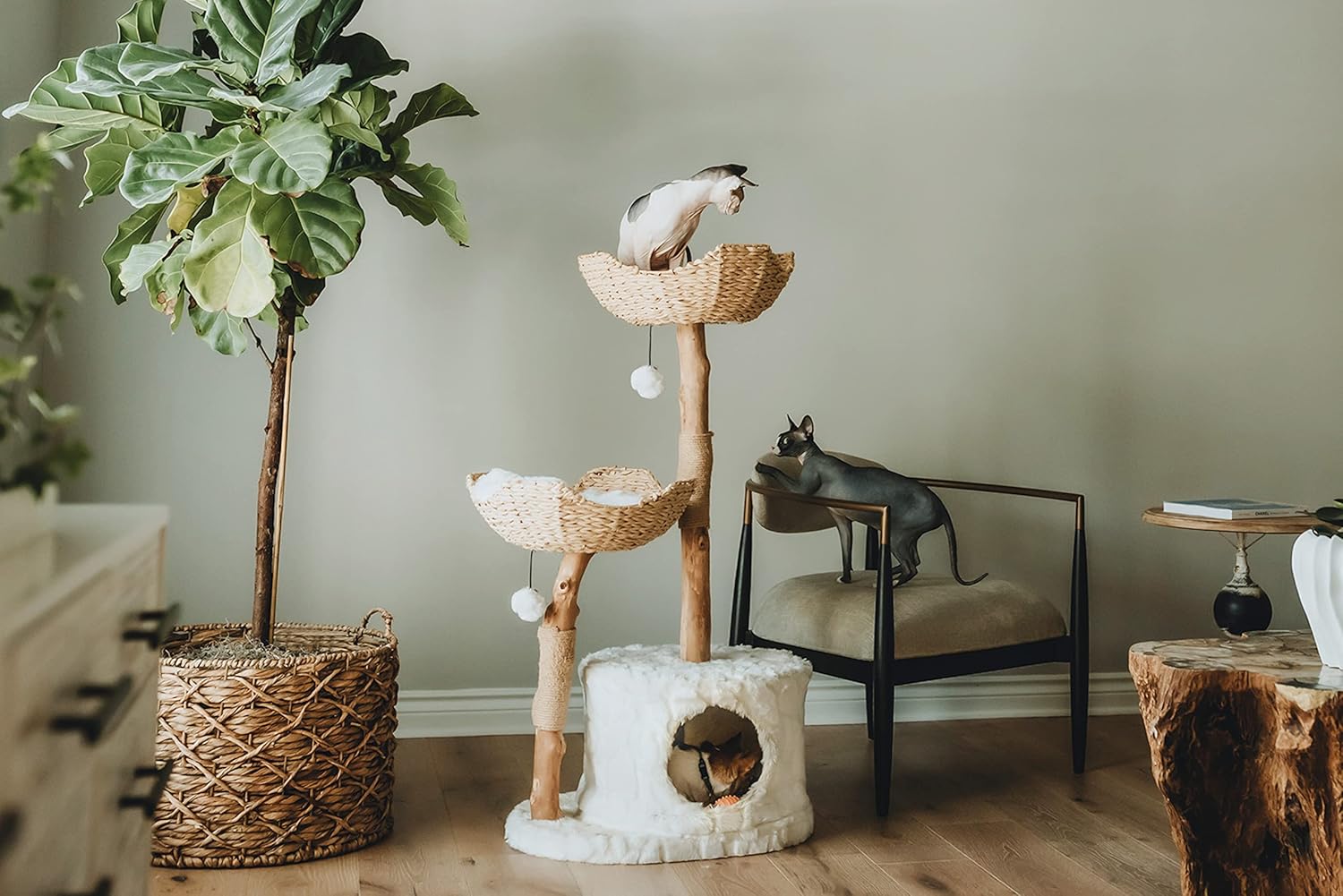
If you’ve been shopping for a cat tree recently — a freestanding structure that gives cats places to climb, perch, scratch, and nap — you’ve probably noticed a wave of designs that look more like boutique furniture than pet-store staples. These pieces use natural materials: rattan (a vine-based palm stem woven or bent into frames and panels), wicker (a weaving technique applied to rattan, reed, or bamboo), and real sisal (a stiff plant fiber twisted into rope and wrapped around posts). The appeal is obvious. A honey-toned rattan arch or a sisal-wrapped walnut post reads as interior décor first and cat furniture second. But natural materials also raise honest questions: Can they hold a 15-pound Maine Coon? Will the weave survive a determined scratcher? Does rattan splinter when it fails? This guide answers those questions with research-backed specificity so you can make a confident call — whether you’re eyeing a $90 mid-range piece or a $400 designer structure.
What “Natural Material” Actually Means on a Cat Tree Label
Marketing copy is generous with the word natural, so it helps to establish a shared vocabulary before evaluating any specific product.
Rattan refers to the solid or hollow stem of climbing palms in the genus Calamus. When used in cat furniture, it typically appears as bent-frame arches, circular perch rings, or woven panel walls. Solid-core rattan is stronger and splinter-resistant; hollow rattan (sometimes labeled reed or cane) is lighter but more brittle under sustained pressure. The difference matters: a cat that jumps rather than climbs exerts sharp point-load force, and hollow-core rattan can crack at the stress point over months.
Wicker is not a material — it’s a construction method. A piece labeled “wicker” could be woven from rattan, water hyacinth, seagrass, or paper cord. When you see “wicker cat tree,” check the underlying material. Rattan wicker is the most durable. Paper or fiber wicker is the least, and some reviewers on aggregated retail sites note it frays within weeks under active scratching.
Sisal is where the sharpest material divide exists. Real sisal is made from the agave plant’s leaf fibers — stiff, coarse, and nearly identical to what wild cat claws evolved to shred. Cats prefer it overwhelmingly over synthetic alternatives, per behavioral research cited by the Cornell Feline Health Center in their scratching overview. Sisal-look fabric (also sold as “sisal fabric” or “sisal carpet”) is a woven textile with sisal-like texture but far less fiber depth — cats shred through it in weeks rather than months. The tell: real sisal rope feels scratchy and slightly oily to the touch; sisal fabric feels smooth and flat. On a post, real sisal rope has visible spiraling; sisal fabric wraps flat like carpet.
The Three Performance Variables That Decide Longevity
Once you’ve decoded the material labels, three structural variables determine whether a natural-material cat tree survives multi-year use.
1. Base Weight and Anti-Tip Geometry
The single most common failure point in any cat tree — natural or synthetic — is tipping. A cat landing on a high perch from across the room applies lateral force well above what static weight tests reveal. International Cat Care’s environmental enrichment guidance emphasizes that unstable climbing structures create not just injury risk but behavioral aversion: cats that tip a tree once often abandon it entirely.
For natural-material trees, base design is complicated by the fact that rattan and wicker frames are lighter than equivalent steel or MDF structures. A 48-inch rattan arch with a 12-pound capacity rating may have a base plate that’s genuinely inadequate for a confident jumper. Look for:
- Base-to-height ratio of at least 1:3 (base diameter or width should be at least one-third of total height)
- Wall-anchor hardware included — for any tree over 40 inches, this is near-mandatory
- Weighted base platforms — some premium designs embed a steel plate inside a wood or rattan base to lower the center of gravity without showing it
Published specs from brands like Tuft + Paw and MiaCara consistently list base plate dimensions and anchor compatibility; budget pieces frequently omit this data, which is itself a signal.
2. Sisal Post Diameter and Wrap Density
PetMD’s behavioral overview of scratching explains that cats scratch to shed claw sheaths, stretch musculature, and mark territory — and they apply meaningful force doing it. A sisal post that works long-term needs at minimum 3 inches in diameter and rope wound at less than 1/4-inch gaps between coils. Posts under 2.5 inches flex during use and accelerate rope loosening. Thin wrapping means the post looks good in product photos but exposes the underlying material (usually MDF or cardboard core on budget pieces) within a few months.
Across aggregated reviews at mid-range retailers, the pattern is consistent: owners who purchase cat trees with 4-inch solid-wood sisal posts report the wrapping lasting 18–24 months before needing replacement, while those with 2-inch hollow-core posts report visible core exposure in under six months.
3. Joinery: Where Natural Material Structures Actually Fail
Rattan and wicker frames are assembled at joints. On quality pieces, those joints use metal hardware or reinforced mortise-and-tenon joinery and are then covered with natural cord or rattan binding. On budget pieces, joints are held by staples or glue concealed under cord wrapping. You can’t always see this in product photos, but you can check:
- Does the manufacturer describe joinery method in specs?
- Are user reviews mentioning wobble or joint failure at 3–6 months?
- Does the piece ship flat-pack or pre-assembled? (Flat-pack rattan with user-assembled joints is higher risk than factory-assembled frames.)
By the Numbers
| Spec | Budget tier ($60–$120) | Mid-range ($150–$300) | Premium ($350–$600) |
|---|---|---|---|
| Typical sisal post diameter | 2–2.5 in | 3–3.5 in | 4+ in |
| Base plate width (avg) | 14–16 in | 16–20 in | 20–26 in |
| Stated weight capacity (top platform) | 11–15 lb | 15–22 lb | 22–33 lb |
| Wall-anchor hardware included | Rarely | Sometimes | Usually |
Specs compiled from published product listings across major retailers as of May 2026. Individual products vary; always verify before purchase.
Where the Premium Pieces Actually Earn Their Price
Apartment Therapy’s roundup of cat trees designed to integrate with human living spaces calls out a consistent pattern: the pieces that hold up aesthetically and structurally over time tend to use solid-wood frames (walnut, oak, or beech) as the load-bearing skeleton, with rattan or wicker as a surface treatment rather than the primary structural material. This is the key design philosophy distinction at the $300+ tier.
MiaCara’s rattan-accented structures, for example, use powder-coated steel or solid wood as the central post and frame, with rattan woven panels as aesthetic add-ons — not load-bearing elements. That’s materially different from a budget piece where rattan is the structural column. The premium price is partly buying the frame engineering hidden behind the beautiful surface.
Moderncat.com’s natural material pet furniture coverage makes the same observation: the most owner-praised pieces at the $400–$600 tier consistently earn that praise from structural integrity, not just aesthetics. Owners in long-run reviews note that the rattan elements stay tight and unsplintered after 2–3 years because they were never the thing holding the cat’s weight.
What Actually Happens When Rattan Fails
This is worth stating plainly because it affects the safety calculus: rattan and wicker, when they fail under point-load stress, tend to crack and splinter rather than bend. A synthetic fleece or carpet-covered post that fails goes soft or compresses; a rattan panel that cracks can expose sharp edges at cat-jump height. Owners in aggregated reviews of hollow-core rattan trees occasionally report a cat catching a paw on a cracked panel edge — not a catastrophic injury risk in most cases, but a real one worth weighing.
The practical upshot: if you’re buying rattan for aesthetics, make sure the rattan is aesthetic — a surface treatment on a solid structural core — not the structural element itself. If a manufacturer won’t confirm what the primary load-bearing material is, treat that as a red flag.
The Decision Framework
You’re weighing aesthetics, durability, price, and your specific cats. Here’s how to resolve the tradeoffs:
If your cats are under 10 pounds and primarily use the tree for napping and light scratching, a mid-range rattan or wicker-framed tree ($120–$200) with a 3-inch sisal post is a reasonable buy. The structural demands are lower, and the aesthetic payoff is real.
If you have one cat over 12 pounds or any cat that’s a confirmed aggressive jumper, prioritize a solid-wood or steel frame with rattan as a secondary material. Budget at least $250–$350, and verify the stated weight capacity applies to the top platform, not just the base.
If you’re managing multiple cats or running a cattery, the math changes: durability per dollar matters more than purchase price. A $400 walnut-and-rattan piece that lasts four years and survives three cats costs less than two $180 budget pieces that fail at 18 months each. Long-run reviews of premium structures consistently show the replacement cycle extending dramatically with quality joinery and solid-core posts.
If the aesthetic goal is a specific interior style (mid-century, Japandi, coastal), make sure the piece you’re considering uses rattan as a surface material on a solid frame rather than as the frame itself. Consult the manufacturer’s material description, not just the product photography — what looks identical in photos may be structurally opposite.
If washability matters (and for cat furniture, it usually does), note that natural materials cannot go in the wash. Removable cushion covers on rattan perch platforms are a necessary feature, not a nice-to-have. Check whether the cover fastens with a zipper or relies on fitted corners — zipper closures survive more removal cycles without losing shape.
The natural-material cat tree category is genuinely delivering on its design promise in 2026, but only at price and construction tiers where the materials are used honestly. Know what’s carrying the load, know what’s carrying the aesthetic — and buy accordingly.