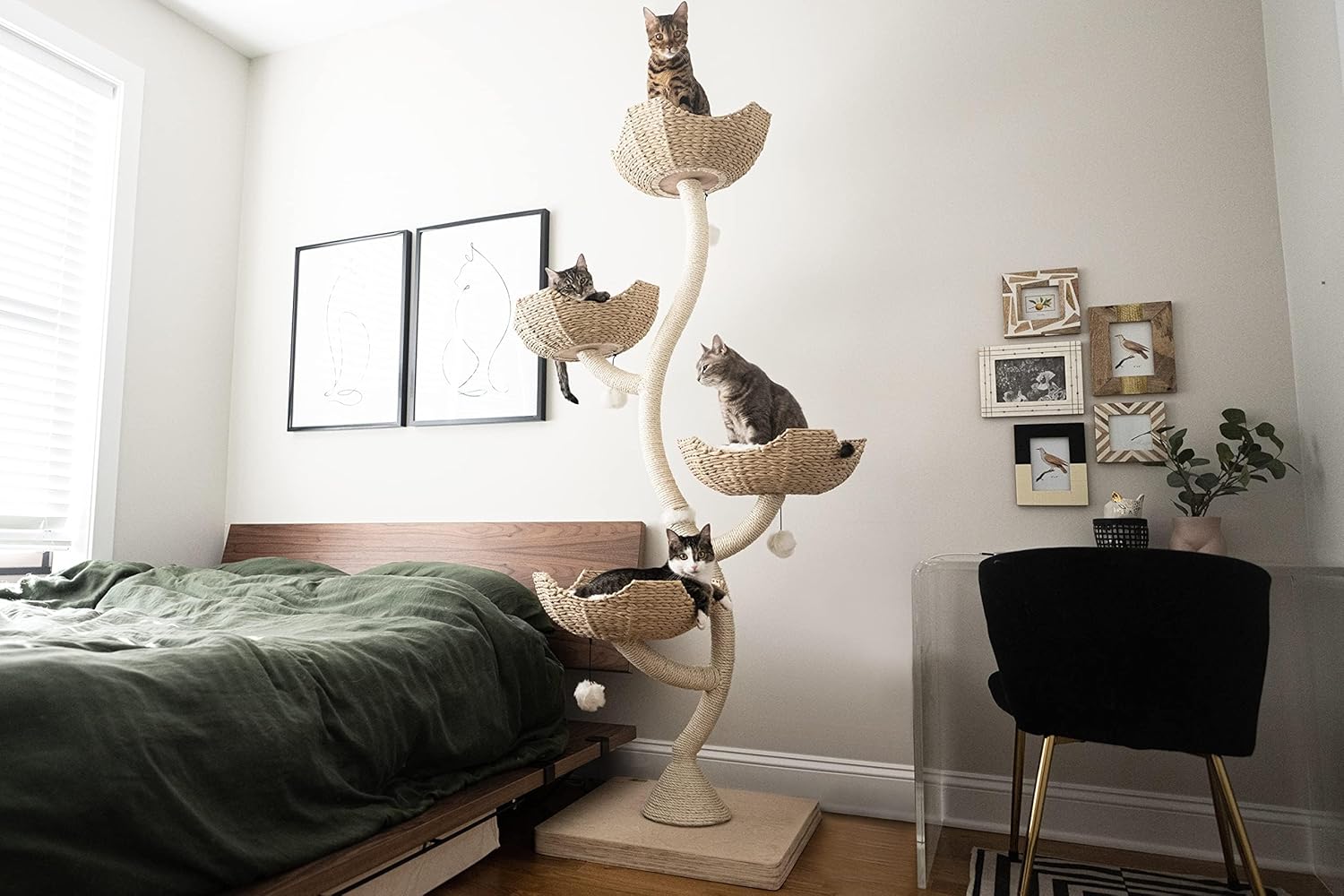
If you’ve recently added a second or third cat to your household — or you’re planning to — you’ve probably noticed that furniture math doesn’t scale the way you’d expect. One cat, one bed, one scratching post: simple. Three cats, three of everything? Not quite. Cats are territorial animals, meaning they have strong instincts about owning their own space, and sharing doesn’t come naturally to them the way it might for dogs. A resource, in cat behavior terms, is anything a cat considers valuable and worth defending: a resting spot, a high perch, a scratching surface, even a window ledge. When resources feel scarce — even in a house full of nice furniture — cats compete. That competition shows up as stress, aggression, and the kind of furniture destruction that makes you question your life choices. This guide gives you a working formula for how many perches, posts, platforms, and beds you actually need, at what price tier it makes sense to invest, and how to think about placement before you spend another dollar.
The Core Formula: N+1, and Why It Exists
The rule most cat behaviorists and veterinary professionals converge on is N+1: for every N cats in the household, provide at least N+1 of each key resource category. The Cornell Feline Health Center’s guidance on multi-cat aggression specifically identifies resource scarcity — including insufficient resting and vertical spaces — as a primary trigger for inter-cat conflict. International Cat Care reinforces this in their behavior documentation, noting that cats do not naturally resolve conflict through negotiation; they resolve it through avoidance, which requires enough physical space and enough distinct resources to avoid each other entirely when they choose to.
What does N+1 look like in practice?
By the numbers:
| Cats in household | Scratching posts (min) | Elevated perches/platforms (min) | Dedicated resting spots (min) |
|---|---|---|---|
| 2 | 3 | 3 | 3 |
| 3 | 4 | 4–5 | 4–5 |
| 4 | 5–6 | 6 | 6 |
| 5+ | N+1 per category, distributed across multiple rooms |
The N+1 rule applies per category, not per piece. A cat tree with three platforms counts as three elevated perches. A single large cat tree with one platform counts as one. This is a distinction that matters enormously when you’re trying to decide whether a $350 modular climbing wall earns its price in a three-cat home — more on that in a moment.
Breaking Down the Resource Categories
Not all furniture serves the same behavioral function. Before you buy anything, it helps to understand the four categories your cats actually care about, and what makes a piece genuinely functional versus decoratively adequate.
1. Vertical Territory (Perches, Platforms, Cat Trees)
Cats use height to establish social hierarchy and to feel safe. In a multi-cat home, vertical space — measured in distinct elevated spots at different heights — is the single highest-impact category. A single-level cat tree satisfies one perch. A floor-to-ceiling modular system like those from brands reviewed by Apartment Therapy’s home-and-pet coverage (including designs by Tuft + Paw and similar contemporary makers) can satisfy four or five perches in the same floor footprint.
The tradeoff is real: a $180 mid-range cat tree with three platforms covers three perch units for two cats in one room. A $480 modular wall-mounted climbing system covers six or seven perch units for a three-cat household and reclaims floor space, which matters in apartments or design-forward interiors where a freestanding tower feels like a visual intrusion. If your primary constraint is floor space rather than budget, the modular wall system pays for itself behaviorally.
Watch for: platforms positioned directly above each other. A cat on the lower platform is within paw’s reach of the one above — that’s not two independent resources, it’s one contested resource with a crowding problem. Genuine vertical separation (staggered horizontally, not stacked) is what makes multiple platforms behaviorally meaningful.
2. Scratching Surfaces (Posts, Pads, Panels)
Scratching is not optional behavior — it’s how cats maintain their claws, stretch their shoulder and back muscles, and deposit scent marks that signal territorial ownership. The ASPCA’s cat care guidance notes that insufficient scratching options are one of the most predictable causes of furniture destruction in multi-cat homes, because cats will escalate marking behavior when they feel territorial pressure.
The material spec here matters more than most marketing suggests. Sisal rope and woven sisal fabric are the two surfaces owners across aggregated reviews consistently report as most satisfying to cats and most durable over time. Carpet-wrapped posts remain popular in the mid-range ($40–$90) but owners frequently note that cats lose interest once the nap flattens — typically within six to twelve months of regular use. Corrugated cardboard scratchers are inexpensive and genuinely functional, but they need replacement every three to four months under multi-cat use, which changes the real cost calculus.
The post height question: A post needs to be tall enough for a cat to fully extend — that’s approximately 28–32 inches for most adult cats. Posts under 24 inches are nearly universally rejected by adult cats in favor of whatever vertical surface is tall enough, which is usually your doorframe.
3. Resting and Sleeping Spots
This is where the line between “cat furniture” and actual interior investment becomes meaningful. A resting spot is any location a cat will voluntarily occupy for more than twenty minutes — a bed, a windowsill cushion, a lounge platform, a heated pad. The behavioral requirement is separation: resting spots that are visible to each other but not adjacent are acceptable; resting spots that require cats to sleep within a body-length of each other are effectively one resource, not two.
For three or more cats, the distribution of resting spots across rooms matters as much as the count. PetMD’s multi-cat household guidance notes that resources clustered in a single room still create competition even when the count is technically adequate, because the dominant cat will often patrol and exclude others from the entire room. Two beds in the same bedroom corner fail the functional test if your alpha cat sleeps in one and guards the other.
Heated orthopedic beds deserve a specific mention for households with senior cats (7+) or cats with joint conditions. Owners of multi-cat senior households consistently report that adding even one or two heated pads dramatically reduces nighttime conflict, because the heated surface becomes so desirable that distributing them across separate rooms creates genuine territorial separation rather than competition.
4. Observation Points (Window Perches, High Shelves)
Distinct from elevated platforms in cat trees, observation points are fixed positions with an exterior view — windows, elevated wall shelves overlooking a room, or positions near sliding doors. Cats use these for environmental monitoring, which is a separate behavioral drive from resting or scratching. International Cat Care’s behavioral documentation identifies window access as a significant welfare factor for indoor-only cats, not merely a luxury.
In practical terms: if you have three cats and one window perch, you have a flashpoint. The fix is inexpensive — a $25–$45 suction-cup window perch at a second window is one of the highest-ROI purchases in multi-cat furniture math. Check the weight rating before buying; perches rated for less than 30 lbs are a safety issue for larger cats, and many budget options hover at 20–25 lbs with optimistic spec sheets.
Budget Allocation Logic for Multi-Cat Households
Here’s where the intermediate practitioner question gets sharper: given a fixed budget, how do you prioritize across these four categories?
The behavioral research points clearly to vertical territory first. A three-cat household with one adequate cat tree and no wall-mounted options has a structural resource deficit that no number of floor-level beds will fix. Cats under-resourced in vertical space will claim and defend any available high point — tops of refrigerators, bookshelves, your $400 sideboard — because the drive to occupy height is not negotiable.
A working allocation framework for a three-cat home at different total budgets:
$150–$300 total outlay: Prioritize one multi-platform cat tree (three or more platforms, sisal-wrapped posts, minimum 60 inches tall) in the main living area at $90–$150, two to three floor-level scratchers or sisal wall panels at $15–$25 each, and one or two budget window perches. Resting spots can be met with washable pillow beds in separate rooms at $20–$35 each. This budget tier is resource-adequate for basic N+1 compliance but offers no margin for design integration.
$300–$600 total outlay: This is where the tradeoff between a premium single piece and adequate coverage across all four categories becomes the central decision. A $380 designer cat tree with premium materials (solid wood frame, wool-blend platforms) satisfies vertical and resting needs but likely leaves scratching and observation points under-resourced. The better allocation at this tier is usually a mid-range cat tree ($130–$180), two sisal wall-mounted scratching panels ($40–$60 each), and one or two quality window hammock perches ($50–$70 each). Total: $260–$380, leaving budget for a heated orthopedic bed in a separate room.
$600–$1,200+ total outlay: At this level, modular wall-mounted systems from brands like Tuft + Paw or MiaCara begin to make genuine sense for design-forward households, because they consolidate vertical, resting, and observation functions into a single wall installation that reads as interior architecture rather than pet furniture. Owners in aggregated reviews of these systems consistently note the space efficiency in apartments and open-plan homes as the primary value driver, not the aesthetic alone.
The Decision Rules
If you’ve been building a mental model across this article, here are the explicit if/then conclusions:
If your cats are showing any inter-cat aggression, guarding behavior, or stress grooming → audit your vertical resource count first, before adding floor-level furniture. The Cornell Feline Health Center’s aggression documentation consistently identifies vertical scarcity as the proximate cause in the majority of multi-cat conflict cases.
If your budget is under $300 for a three-cat household → prioritize count over quality. Three functional $40 sisal posts beat one beautiful $150 post every time.
If your household has four or more cats → room distribution matters as much as total count. A cluster of premium furniture in one room leaves the rest of the apartment behaviorally impoverished. Spread resources across at least three rooms.
If you have senior cats mixing with younger cats → add one heated pad per senior cat, placed in a separate room from the main climbing area. The age-related preference divergence is strong enough that this single move typically reduces nighttime conflict.
If you’re in a design-forward home and floor space is the constraint → wall-mounted modular systems are the correct answer at the $500+ tier. The floor-space recovery and visual integration genuinely justify the premium over freestanding towers.
The math is not complicated, but it’s easy to undercount. Count platforms, not pieces. Distribute across rooms, not just across a single room. And remember that N+1 is a floor, not a target — more is usually better, as long as placement is thoughtful.