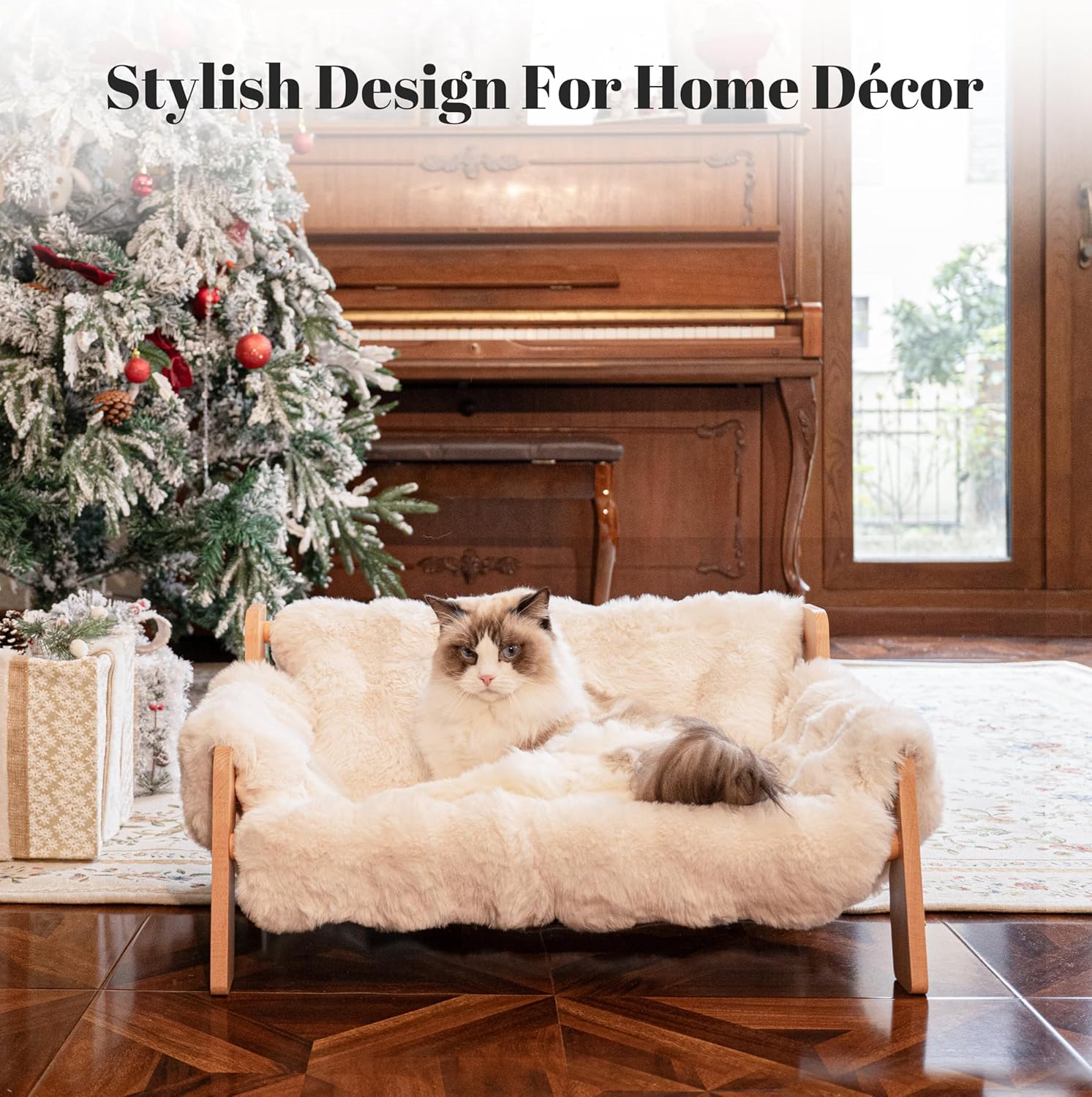
Most cat beds on the market are designed around a cat’s indifference — they’re cheap, fleece-covered foam rounds that pile up in a corner and clash with everything you’ve worked to make your home look like. If you’ve spent real money on a sofa or a rug, you already know the feeling: the cat picks the $14 cushion over the $90 bed you bought, and now that $90 bed is an eyesore you can’t quite justify throwing away. The good news is that the category has matured significantly. What’s now called a “design-forward cat bed” — meaning a cat bed engineered to look like an intentional piece of interior furniture, with a washable fabric cover (a cover that unzips or snaps off for machine laundering) and a real wood or powder-coated metal base — has moved from niche to competitive market segment. This guide walks you through exactly what separates a genuinely well-built option from a good-looking prop, what owners consistently report across price tiers, and how to make a clear call on where your money should go.
What “Washable Cover” and “Real Wood Legs” Actually Mean in Practice
These two phrases do most of the marketing work in this category, and they’re worth interrogating before you spend anything over $60.
Washable covers exist on a spectrum. At the low end, “washable” often means the entire bed — foam base included — can technically go in a large-capacity machine on cold, but the cover isn’t separately removable. That matters because a non-removable cover means you’re stuffing a bulky foam object into your washer every time there’s an accident, which most owners report doing no more than once before they stop bothering. A genuinely useful washable cover unzips or snaps off independently, slides into a standard top-loader or front-loader without drama, and comes out without pilling or shrinking after repeated cycles. Apartment Therapy’s coverage of aesthetically integrated cat furniture consistently flags cover-removal ease as the single most differentiating feature between beds owners actually keep clean and beds that slowly accumulate fur in a corner.
Material matters almost as much as removability. Wool bouclé (a looped-yarn fabric with a textured, nubby surface — the same material you’d see on a designer accent chair) is visually impressive but requires either hand-wash or a delicate cycle and tends to pill with cat claws over time. Performance velvet and tightly woven cotton canvas hold up significantly better across weekly wash cycles. Owners in aggregated reviews of mid-range and premium beds consistently report that canvas-covered bases outlast bouclé by a wide margin when lived-in with active cats.
Real wood legs is where marketing fluff peaks. “Solid wood” and “wood legs” are not the same spec. Solid wood — typically beech, rubberwood, ash, or walnut depending on price tier — is milled from a single piece and won’t delaminate or bow under load. MDF (medium-density fiberboard, a wood composite pressed with resin) legs with a walnut veneer look identical in product photography and cost a fraction as much to produce, but they fail at joints after repeated moisture exposure from cleaning, and they can’t hold a screw as reliably when reassembled. If a listing doesn’t specify species and construction method, the safest assumption at the $40–$80 price point is that the legs are MDF-core or hollow-formed wood composite.
At the $150–$300 range, brands like Tuft + Paw and Hepper publish material specs in detail — solid rubberwood or beech at those price points is standard and verified in owner reports. Above $300, designers like MiaCara use solid European beech or walnut with furniture-grade joinery, and owners reviewing those products on moderncat.com and Apartment Therapy consistently note that the base construction holds up to multi-year daily use.
The Price-to-Value Tradeoffs, Named Honestly
Here’s where most buying guides lose the thread: they rank products without naming the tradeoffs that make one option better than another for a specific household. Let’s be direct.
By the numbers — what each tier actually buys you:
| Price tier | Cover construction | Base material | Avg. owner wash rating | Design integration |
|---|---|---|---|---|
| $15–$50 | Non-removable or velcro flap | MDF / hollow composite | Low (1–2x/month reported) | Minimal |
| $60–$130 | Zip-off cover, polyester or canvas | MDF-core with veneer | Moderate (weekly viable) | Moderate |
| $150–$300 | Zip-off, canvas or performance fabric | Solid rubberwood or beech | High (weekly, multi-year) | Strong |
| $300–$600 | Zip-off or button-off, wool/bouclé/linen | Solid walnut or European beech | High, but care-label dependent | Furniture-grade |
The jump from the $60–$130 tier to the $150–$300 tier is the one that consistently earns the strongest owner endorsement — you’re moving from MDF composite to actual solid wood, and from a cover that survives washing to one that’s designed to survive it repeatedly. PetMD’s guidance on cat bed selection notes that cats under 15 lbs. aren’t creating meaningful structural load on any of these bases, so paying for solid walnut over solid rubberwood is primarily an aesthetic and longevity decision, not a weight-rating safety issue.
The jump from $150–$300 to $300–$600 buys you furniture-grade visual integration — the piece genuinely looks like it belongs next to a Muuto side table or a Floyd sofa — and in some cases a longer-lasting fabric. But it often introduces a care-label complication: wool bouclé at $400 may require dry cleaning or hand washing, which practically reduces cleaning frequency for most households. If you have a cat prone to hairballs or accidents, a $180 canvas-covered bed with solid rubberwood legs is the better long-term decision than a $450 bouclé piece, even if the bouclé reads better in your living room on day one.
What to Look For by Interior Style
This is the part most buying guides skip, and it’s the question design-forward owners actually show up with. “Modern cat bed” is not a single aesthetic — it covers at least four distinct interior vocabularies, and a piece that’s perfect for one looks wrong in another.
Mid-century modern (tapered legs, warm wood tones, low profiles): Look for solid walnut or teak-finish beech legs with a 15–18° taper, and covers in warm neutrals — oat, camel, warm white. Tuft + Paw’s Cove bed and Lords & Labradors’ rounded lounger range are frequently cited in Apartment Therapy’s mid-century pet furniture roundups as the strongest fits here. The profile should sit low — 6–10 inches off the ground — to match the horizontal emphasis of the style period.
Scandinavian / Nordic minimalist (light woods, white and cool-grey palette, clean geometry): Beech or ash in a natural or whitewash finish, paired with a textured cotton or linen cover in off-white, light grey, or sage. MiaCara’s Dogi and Letto lines are the editorial reference point moderncat.com returns to most consistently for this aesthetic. The form language is simple to the point of severity — no curves, no tufting.
Contemporary / transitional (the broadest category — mixes materials, warmer greys, some contrast): This is where the most options exist and where the category competes hardest. Hepper’s Pod and Wave beds work in transitional spaces because the silhouette is distinctive without being period-specific. Performance velvet covers in jewel tones (deep green, rust, navy) photograph beautifully here and, importantly, are the most durable fabric option for weekly washing.
Industrial / urban (powder-coated steel, raw materials, darker palette): This is the thinnest part of the market. Most “design cat beds” default to warm wood and soft fabric, which can read out of place in a loft with exposed concrete. The workaround most owners in this aesthetic gravitate toward: a powder-coated steel frame with a removable canvas insert, or a simple elevated platform in dark-stained oak. International Cat Care’s environmental enrichment guidance notes that elevated resting spots are genuinely preferred by most cats — a steel platform at counter height serves the cat’s behavioral needs and the owner’s aesthetic simultaneously.
Decision Rules: If X, Then Y
This is the frame that should govern your purchase.
If you have one cat, no accident history, and a mid-century or Scandinavian interior: Spend $150–$300. The solid rubberwood base and canvas zip-cover tier gives you real wood, honest washability, and visual integration without the bouclé care complications. This is the clear value peak of the category.
If you have two or more cats, or one cat with a hairball or elimination issue: Prioritize cover washability over aesthetics. A $120 bed with a performance-velvet zip cover that goes through a hot wash weekly will serve you better over three years than a $380 bouclé piece you’re afraid to put in the machine. Per Cornell Feline Health Center’s guidance on multi-cat household hygiene, wash frequency correlates directly with stress reduction and territorial behavior — a bed that’s easy to launder is a functional health investment, not a compromise.
If your primary goal is design integration in a high-visibility room: Budget $250–$450 and go in with eyes open on the fabric care label. Read it before you buy, not after. If it says dry-clean only and you have a cat that sheds heavily, reconsider. Owners in aggregated reviews of premium wool-covered beds consistently report that shedding is manageable but that any moisture incident makes the cleaning obligation prohibitive.
If you’re outfitting a boutique cattery or managing five or more cats: The unit economics favor mid-range durability over premium aesthetics. A $120–$160 canvas-covered solid-base bed that holds up to 18-month rotation and weekly washing outperforms a $400 piece on a 36-month total-cost basis. PetMD’s buying framework for multi-cat environments specifically highlights cover replaceability — look for brands that sell replacement covers separately, which reduces cost-per-cycle when fabric wears before the base does.
If the legs matter more than the cover (you’re buying for a visible room, and the base will show constantly while the bed is in use): Spend where it counts — solid wood over MDF every time, even if it means stepping down on cover fabric. A $180 bed with solid rubberwood and a basic cotton canvas cover reads better in a considered interior than a $120 bed with a luxe-looking velvet cover on MDF-composite legs that bow at the joints after six months.
The market has genuinely good options at every price point discussed here. The mistake most owners make isn’t spending too much or too little — it’s buying for photography rather than for the cat’s actual use patterns and their own cleaning habits. Match the spec to the real household, and the design integration follows.