If you have ever stood in front of a $400 cat tree and thought, “This looks like real walnut — but is it?” you have already identified the central problem with the designer cat-furniture market. A cat tree is a vertical climbing and resting structure purpose-built to satisfy a cat’s instinct to perch, scratch, and survey its territory from height — needs that International Cat Care identifies as foundational to indoor feline welfare in its Environmental Enrichment guidance (icatcare.org). The construction material — solid wood versus particleboard wrapped in a veneer or contact paper — determines how long the piece lasts, how stable it stays, and whether it ever actually looks the way the product photo suggests after a year of claws and fur. This guide breaks down the real difference between those two construction paths, names the tradeoffs honestly, and ends with a clear decision rule so you know which category to buy into before you commit.
Why Construction Material Matters More Than the Label
The word “luxury” does real damage in this category. Manufacturers apply it to $89 particleboard towers with faux-wood film just as readily as to $480 frames milled from solid European beech. The gap between those two objects is not aesthetic taste — it is engineering.
Particleboard (also called MDF when it is medium-density fiberboard) is a manufactured wood product: compressed wood fiber, sawdust, and adhesive binders pressed into sheets. It is the dominant substrate in flat-pack furniture, and there is nothing inherently dishonest about using it. The problems emerge when particleboard is used in load-bearing vertical structures — cat-tree columns and horizontal perch shelves — without adequate internal reinforcement, and then wrapped in a photographic wood-grain film or thin veneer to imply solid-wood construction. Edge chips reveal the substrate immediately. Water from a spilled bowl or a cat’s tracked litter causes swelling that cannot be reversed. Hardware threads strip after the second disassembly. Cornell University College of Veterinary Medicine’s feline health resources (vet.cornell.edu, “Cats and Scratching”) note that cats use vertical structures dynamically — launching, landing, and shifting weight suddenly — which means the structure experiences cumulative stress that a static bookshelf never does. Particleboard tolerates that stress poorly over time.
Solid wood — actual milled lumber, whether pine, birch, walnut, beech, or oak — does not chip at edges the same way, holds threaded hardware reliably across multiple reassemblies, resists moisture at the surface (though it still warrants sealing), and develops a patina rather than peeling. A solid-walnut platform scratched lightly by a cat looks lived-in; a walnut-film-wrapped particleboard platform looks damaged.
Engineered wood with honest framing — plywood (cross-laminated wood veneer layers) and bamboo composites — occupies a middle tier worth distinguishing from standard particleboard. Baltic birch plywood, for instance, holds screws significantly better than MDF, resists edge chipping, and is used by several well-regarded mid-market brands in their perch platforms precisely because it offers dimensional stability at lower cost than solid hardwood. When a brand specifies “birch plywood frame” rather than claiming solid wood, that is transparent construction language and it deserves credit.
Reading the Spec Sheet: What Brands Actually Tell You (and What They Hide)
Once you know what to look for, brand spec pages sort themselves quickly. Here is the translation guide.
Phrases that are doing honest work:
- “Solid [species] wood frame” — commits to species and process
- “Baltic birch plywood platforms” — transparent engineered-wood disclosure
- “Powder-coated steel hardware” — hardware grade matters for column stability
- “Kiln-dried timber” — moisture control during manufacturing, relevant to long-term stability
Phrases that require follow-up questions:
- “Premium wood finish” — finish is not substrate; this tells you nothing about what is underneath
- “Real wood texture” — texture is a surface property; it describes the wrap film, not the core
- “Engineered hardwood” — can mean anything from quality plywood to MDF with a hardwood veneer; ask which
- “Natural materials” — also covers jute, sisal, and recycled cardboard, not necessarily the frame
Phrases that are almost always marketing:
- “Luxury craftsmanship” without a species name
- “Wood-look” or “wood-tone” — almost always contact paper or vinyl film
- “Artisan construction” with no workshop location or process detail
Apartment Therapy’s ongoing coverage of cat-furniture integration into designed interiors consistently flags this pattern: the price point of designer cat furniture has outrun the transparency of its material disclosures, leaving buyers to reverse-engineer construction from weight, shipping dimensions, and product review threads. A 40-pound shipping weight on a mid-size cat tree is a reasonable signal of solid-wood or dense plywood construction. A 17-pound shipping weight on the same footprint suggests hollow or particleboard columns regardless of the finish shown in photography.
Comparing the Three Construction Tiers
The market sorts into three distinct tiers based on core material. Each tier has a genuine use case — the goal is matching the tier to your actual household conditions, not chasing the most expensive option by default.
Budget Tier: Particleboard and MDF Core
Particleboard and MDF-core cat trees dominate the $60–$180 price band. At their best, they offer a low commitment entry point for single-cat households with small cats, renters who move frequently and prefer not to invest in permanent furniture, and owners testing whether a particular size or configuration works in their space before upgrading.
The honest limitations: owner-reported useful life across review aggregations tracked by Modern Cat’s buyer guide coverage centers around two to four years under normal use. Hardware threads strip after one or two disassemblies, making moves problematic. Moisture exposure from water bowls or humid environments accelerates edge degradation. The finish — almost always a photographic film or thin paper veneer — begins to peel or chip at contact points within the first year of active use by a cat with intact claws.
Stability is the sharpest limitation. Particleboard bases flex under dynamic load, meaning a cat that launches off the top platform imparts torque that a flexible base does not fully resist. In multi-cat households or homes with cats over 12 lbs, wall anchoring is typically required almost immediately for freestanding safety.
 product image](/images/external/2aca67ca21d4.jpg)
Tangkula
$149.99
In stock on Amazon
Check price on AmazonMid-Range Tier: Plywood and Baltic Birch Core
Plywood-core and Baltic birch constructions occupy the $150–$320 band and represent the honest performance sweet spot for most households. Cross-laminated veneer layers give plywood dramatically better screw-holding capacity than MDF — hardware survives four to six disassembly and reassembly cycles reliably — and edge chipping is largely eliminated. Dimensional stability under moisture is meaningfully better than particleboard, though surface sealing still matters.
Owner-reported useful life in this tier centers around five to eight years. The column-to-base connection, the most common failure point in cat trees, holds reliably when the base platform is plywood rather than MDF because the base does not flex. Freestanding stability without wall anchoring is achievable for most single-cat and two-cat configurations even with medium-to-large cats.
Hepper’s product line occupies this tier credibly. Their Scandinavian-adjacent aesthetic is backed by construction weights consistent with plywood-grade substrates rather than hollow MDF columns. Material disclosures on some product pages use the phrase “manufactured wood” where species specificity would be more reassuring — buyers seeking absolute confirmation should contact customer service directly — but weight-to-size ratios and aggregated owner notes suggest plywood-grade core material in their climbing structures.
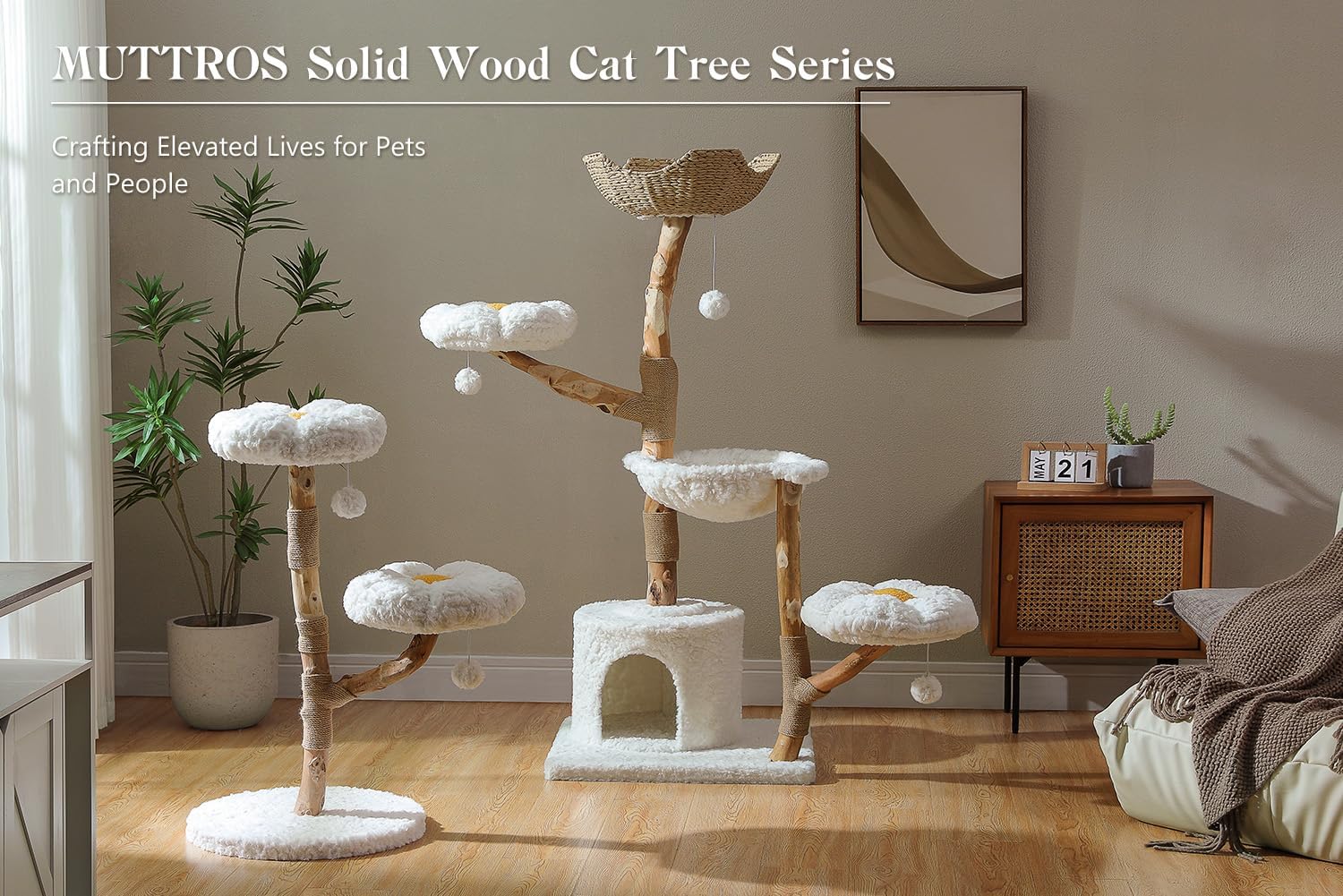
MUTTROS
$159.59
In stock on Amazon
Check price on AmazonPremium Tier: Solid Hardwood Core
Solid hardwood cat trees — frames milled from beech, birch, walnut, or pine — occupy the $280–$600-plus band and are the only tier that genuinely earns the “luxury” label on structural grounds.
Hardware integrity is the clearest differentiator: solid hardwood holds threaded fasteners through eight or more disassembly cycles without degradation, which matters practically for households that move or rearrange furniture. Owner-reported useful life in this tier ranges from eight to fifteen years. A scratched solid-walnut platform develops a patina; the same surface on particleboard peels.
Two brands in this tier stand out for material transparency. Tuft + Paw publishes species names in product specifications and distinguishes frame material from platform material — their disclosures are among the cleaner examples in the category, and multi-year owner reviews report hardware holding reliably after repeated moves. MiaCara, a German brand, specifies solid European beech and powder-coated steel in its construction descriptions and publishes product weights (25–45 lbs depending on configuration) that align with those claims. Modern Cat’s coverage of the designer segment identifies MiaCara as one of the few brands where design-first positioning is backed by material-first construction.
The cost-per-year arithmetic supports the premium tier for qualifying households: a $480 solid-beech tree lasting twelve years costs approximately $40 per year. A $140 particleboard tree replaced every three years costs approximately $47 per year — net of the larger upfront cost, the premium build is the cheaper option over time.
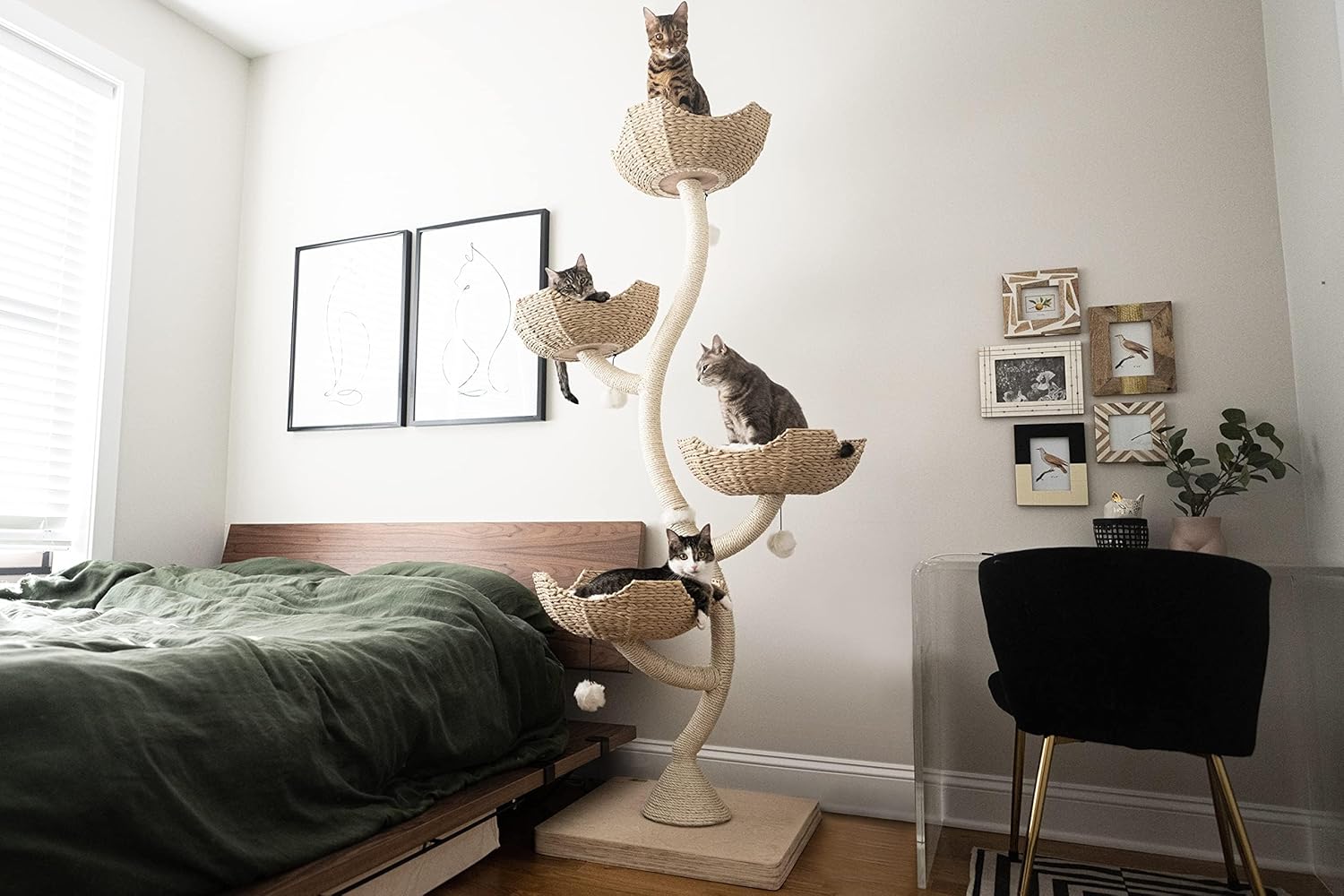
MAU
$399.00
In stock on Amazon
Check price on AmazonThe Sisal and Fabric Layer: A Separate Variable
One complication worth flagging separately: sisal wrapping and upholstered platforms are not just aesthetic choices — they affect structural assessment. A thick sisal-wrapped column disguises the substrate underneath, which makes it genuinely harder to assess construction quality from a photo or even in person. The same is true for thick wool bouclé or felted fabric over a platform.
This matters because some brands invest heavily in surface material quality — natural sisal, hand-tufted wool, Sunbrella-grade fabric — precisely because it is visible and photogenic, while the substrate underneath remains standard particleboard. The surface investment has real value: natural sisal performs better under sustained scratching than polypropylene rope and resists odor better. Cornell University College of Veterinary Medicine’s feline behavior resources (vet.cornell.edu) note that cats engage in scratching to condition claws and leave visual and scent marks, and natural fiber surfaces satisfy that behavioral need more effectively than synthetic alternatives. But sisal quality does not transfer structural integrity to the frame.
The practical check: if a brand specifies a premium surface material in detail but uses vague language about the core construction, ask directly or assume particleboard until confirmed otherwise.
Stability: The Safety Variable That Overrides Aesthetics
For multi-cat households and homes with large-breed cats — Maine Coons, Ragdolls, Norwegian Forest Cats commonly reach 12–22 lbs — stability is not a preference, it is a safety requirement. A tipping cat tree is a real injury risk to both cats and nearby furniture or people. The factors that determine stability are base width relative to height, column thickness, hardware integrity, and whether the base platform is solid enough to hold anchor weight without flexing.
Particleboard bases flex. Solid-wood bases do not. In a floor-standing structure that is not wall-anchored, base rigidity is the primary anti-tip mechanism. Owners in large-cat households consistently report that particleboard-base trees require wall anchoring almost immediately, while solid-wood or thick-plywood constructions are stable freestanding at comparable heights.
International Cat Care’s Environmental Enrichment guidance (icatcare.org) emphasizes that cats need reliable, stable vertical space to express natural perching and territory-monitoring behavior — a structure that wobbles or shifts under dynamic load actively undermines that behavioral function, not just the owner’s peace of mind.
The Decision Rule
The framework is simpler than the category marketing suggests.
If your cats are small to medium (under 12 lbs), you own one or two, you rent or move frequently, and your interior aesthetic is flexible: plywood-core mid-range ($150–$280) is the honest sweet spot. You get meaningfully better longevity and hardware integrity than particleboard, real freestanding stability, and the ability to disassemble and reassemble without structural degradation. Solid hardwood is not necessary to meet your actual use case.
If you own large-breed or multiple cats, or if the piece will live in a primary living space where it functions as furniture first: prioritize brands that name their wood species and disclose weights consistent with solid-wood construction. Expect to spend $300–$550 or more. Verify material disclosure before purchase — if the brand will not name the species, assume MDF. The stability and longevity premium is real, the cost-per-year math supports it, and a piece that looks as good at year five as it did at month one is the actual definition of luxury in this category. Not the label. The construction.
Design-savvy confidence and honest construction do coexist in this market. You just have to know which questions to ask before the purchase, not after the unboxing.