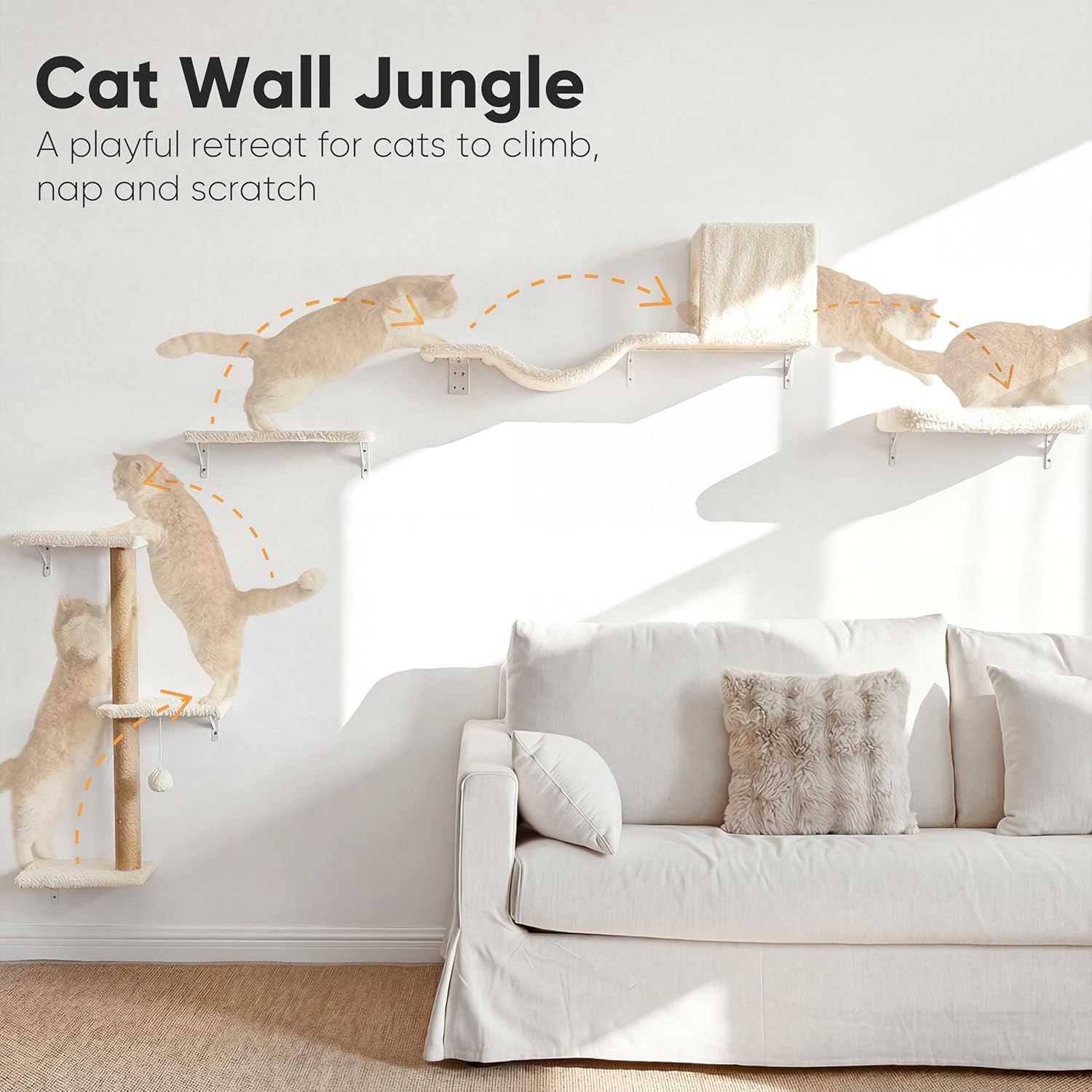
If you share your apartment with a cat and you’ve already bumped your shin on a freestanding cat tree one too many times, wall-mounted cat furniture is probably the idea you’ve been circling. The concept is straightforward: instead of placing a cat tree — those freestanding towers of carpet and particle board — on your floor where it competes with your couch, coffee table, and sanity, you mount shelves, perches, and climbing steps directly to your walls. Your cat gets a full vertical world to explore; you get your floor space back. Done well, the whole system looks intentional — less “pet aisle impulse buy” and more “design-forward apartment with a cat who is clearly thriving.” This guide walks through how to evaluate, spec, and install a wall-mounted cat system at every price point, from a $60 starter shelf to a $400+ modular walnut-and-steel build. Whether you’re renting or own your place, whether your walls are drywall or plaster, there’s a workable configuration here.
| EDITOR'S PICK[INICIO Cat Wall Shelves - Safe…](https://www.amazon.com/dp/B0F6CXZF8L?tag=greenflower20-20) | Mid-tier[XiaZ Cat Wall Shelves](https://www.amazon.com/dp/B0FJFJR4GV?tag=greenflower20-20) | Budget pick[Zakkart Cat Perch for Window Si…](https://www.amazon.com/dp/B0CBTXSBFW?tag=greenflower20-20) | |
|---|---|---|---|
| Weight Limit | 15 lbs | 25 lbs | — |
| Material | Natural Wood | Wood | Hardwood |
| Type | Corner Shelf | Corner Shelf | Window Perch |
| Cushioned | ✓ | — | ✓ |
| Steps | 3 | 3 | — |
| Price | $38.99 | $31.58 | $22.79 |
| See on Amazon → | See on Amazon → | See on Amazon → |
Why Vertical Space Actually Matters (and What the Research Says)
This isn’t just an aesthetic preference. International Cat Care’s Feline Environmental Needs Guidelines — a widely cited framework among veterinary behaviorists — identifies vertical territory as one of five core environmental resources for indoor cats. Cats are naturally inclined to survey their surroundings from height; elevated positions reduce stress by giving a cat control over sight lines and escape routes. Cornell University’s College of Veterinary Medicine’s guidance on environmental enrichment for indoor cats echoes this, specifically noting that wall-mounted perches and cat “highways” (connected paths at height) can reduce inter-cat tension in multi-cat households and lower generalized anxiety in single-cat homes.
For small apartments, this has a practical payoff beyond cat wellness: a cat who has engaging vertical options tends to be less destructive at ground level. If you’re currently losing a couch arm to scratching or finding your cat pacing and yowling, vertical enrichment is one of the first interventions behaviorists recommend before anything else. The wall is doing double duty — enriching your cat’s environment and preserving your furniture.
The Three System Archetypes: Which One Fits Your Setup
Not all wall-mounted cat furniture is the same product category. Before you price-shop, identify which of these three archetypes actually matches your situation.
The Single-Perch Install — One or two shelves, usually 16–24 inches wide, mounted at window height or above a radiator. This is the $40–$90 range. It solves the “my cat wants a window seat but I have no windowsill” problem and nothing else. If you have one cat, a studio apartment, and no ambitions beyond that one perch, this is all you need. The tradeoff is that a single shelf with no connecting path is a destination, not an environment — your cat will use it, but it won’t deliver the full behavioral benefit of an actual climbing route.
The Cat Highway — A connected sequence of shelves, steps, and corner pieces that lets a cat travel a continuous path across one or more walls at height, ideally connecting a launch point (a couch back or tall dresser) to a high resting spot. This is the sweet spot for small apartments: a well-designed highway can run the perimeter of a 400 sq ft studio and give a cat more functional territory than a $300 freestanding tree while consuming zero floor space. Budget: $120–$350 depending on brand and materials.
The Modular Activity Wall — Full systems from brands like Catastrophic Creations, Tuft + Paw, or MiaCara that include integrated scratching surfaces, hammock inserts, hiding boxes, and sisal-wrapped climbing elements. These are designed from the start to be furniture-grade: you’ll see solid wood, powder-coated steel hardware, and upholstery options. Budget: $250–$700+ for a full room build. The target buyer is someone furnishing a permanent apartment who wants the system to look like it belongs on a design blog — which, according to coverage in Modern Cat Magazine’s 2024 designer furniture feature, is exactly the aesthetic these systems are being built to hit.
By the Numbers
| System Type | Typical Price Range | Floor Space Used | Ideal Cat Count |
|---|---|---|---|
| Single perch | $40–$90 | 0 sq ft | 1 cat |
| Cat highway (4–8 pieces) | $120–$350 | 0 sq ft | 1–2 cats |
| Modular activity wall | $250–$700+ | 0 sq ft | 2–4 cats |
| Freestanding mid-range tree | $80–$200 | 4–9 sq ft | 1–3 cats |
Materials and Construction: Where “Premium” Is Real vs. Marketing Noise
This is where intermediate buyers often get burned, so let’s be direct about what matters.
MDF vs. solid wood vs. bamboo. Most shelves in the $40–$150 range are MDF (medium-density fiberboard) with a veneer or paint finish. MDF is not inherently bad — it’s stable, takes paint well, and is lighter than solid wood, which actually matters when you’re bolting things to a wall. The problem is that cheap MDF with thin veneer will chip, swell, and degrade at the edges if it gets wet (hello, water dish splash or hairball situation). If you’re buying MDF, look for a full-paint or thick-lacquer finish rather than a paper veneer edge. Bamboo and solid wood pieces — which you’ll find in the $150+ tier from brands like Catastrophic Creations and Tuft + Paw — take abuse better over the long run, especially in multi-cat homes where there’s constant traffic.
Upholstery on resting surfaces. Carpet remnants are the cheapest option and the hardest to keep clean. Reviewers across aggregated platforms consistently flag carpet-covered shelves as odor traps after 12–18 months. For washability, you want either a removable cushion with a zippered cover (machine-washable is the call; hand-wash-only is a warning sign in a small home), or a sisal/jute wrap, which doesn’t trap odor but also isn’t a soft resting surface — it’s better used on climbing steps than lounge perches. Wool bouclé upholstery, seen on MiaCara’s higher-end pieces, is the aesthetic premium option; owners report it holds up surprisingly well to claw traffic, though it’s expensive to replace if damaged.
Hardware and wall anchors. This is the safety-critical piece and the one most listings underexplain. Shelf-mounted cat furniture puts dynamic load on your wall every time a cat launches off or lands — this is not like hanging a picture frame. The manufacturer’s rated weight capacity is a minimum bar, not a comfort ceiling. For a 12-pound cat landing at speed, you want hardware rated for at least 30–40 lbs per mounting point, per the general load factor guidance from structural home improvement references. In drywall, that means stud mounting or heavy-duty toggle anchors — not the small plastic wall anchors often included in budget kits. If you’re renting, check your lease: some landlords accept patched anchor holes; others don’t. A stud-mounted system will have fewer, larger holes; a toggle-anchor install will have more holes but can go anywhere on the wall.
Apartment Therapy’s small-space pet furniture roundup has noted that renter-friendly systems — those designed around removable adhesive strips or furniture-anchored mounting brackets — are a growing category, though these reviewers consistently flag that adhesive-only mounts are only reliably safe for cats under 10 lbs on shelves with limited jump height. For most cats, stud mounting remains the responsible call.
Design Integration: Making It Look Intentional
The best wall-mounted cat systems disappear into your interior. Here’s how to think about that decision:
Match the finish to your existing furniture, not to other cat products. If your apartment is mid-century modern with walnut tones and black metal legs, a natural wood shelf with matte black hardware reads as furniture. If your space is Scandinavian-minimalist with white-and-oak, a white-lacquered shelf or natural birch piece integrates better than anything in “natural wood” generic brown. Wirecutter’s 2025 roundup of cat trees and shelves specifically calls out the improvement in design language from brands now offering colorways that match common interior palettes — black, white, natural oak, and walnut are the four to look for.
Think about the visual weight of the system on the wall. A cat highway that runs every wall of a small room at 5-foot height will dominate the space — that can be a feature or a problem depending on how you feel about it. A more restrained approach: one feature wall with a full highway, other walls clean. This is also safer structurally in rental situations where you want to minimize anchor points.
Proportion matters. Shelves that are too narrow (under 10 inches) look like afterthoughts and don’t give most cats a comfortable resting surface. Shelves 12–16 inches wide have enough visual weight to read as intentional wall elements. Corner pieces and hammock inserts add visual interest and break up what would otherwise look like industrial storage shelving.
The Decision Frame: If X, Then Y
You’ve got context now. Here’s the explicit decision logic:
If you have one cat and a single problem (no window perch, needs one high resting spot): Buy a single well-made shelf in a finish that matches your room. Budget $50–$90. Don’t over-engineer this.
If you have one or two cats and want genuine behavioral enrichment with a clean aesthetic: Build a cat highway with 5–8 connected pieces. Budget $150–$300. Prioritize brands where the pieces are sold as a system (compatible spacing, matching hardware) rather than mixing shelf brands. Catastrophic Creations’ modular systems and the Tuft + Paw wall shelf line both have documented owner satisfaction in long-run reviews for exactly this configuration.
If you have two or more cats in under 700 sq ft: This is where the modular activity wall earns its cost. The behavioral payoff of multiple separated elevated resting zones — International Cat Care’s guidelines recommend one territory resource per cat plus one additional — is real and measurable in reduced inter-cat conflict. Budget $300–$600 and treat it as furniture, not a pet accessory purchase.
If you’re renting and uncertain about holes: Look specifically for systems with furniture-anchor or tension-post mounting options, and accept that you’re trading some height flexibility for reversibility. Read the system’s rated weight capacity carefully against your cat’s weight — for most adult cats (9–15 lbs), adhesive-only systems are not the safe call regardless of what the packaging says.
If design integration is your primary constraint: Start at the finish, not the feature set. A $200 walnut-finish system that looks right in your apartment will serve you better than a $400 carpeted tower you’re ashamed to show guests. The cat doesn’t care about the veneer. You do. That’s valid.
The vertical space in your apartment is already there. The only question is whether the cat gets it in a way that works for both of you.