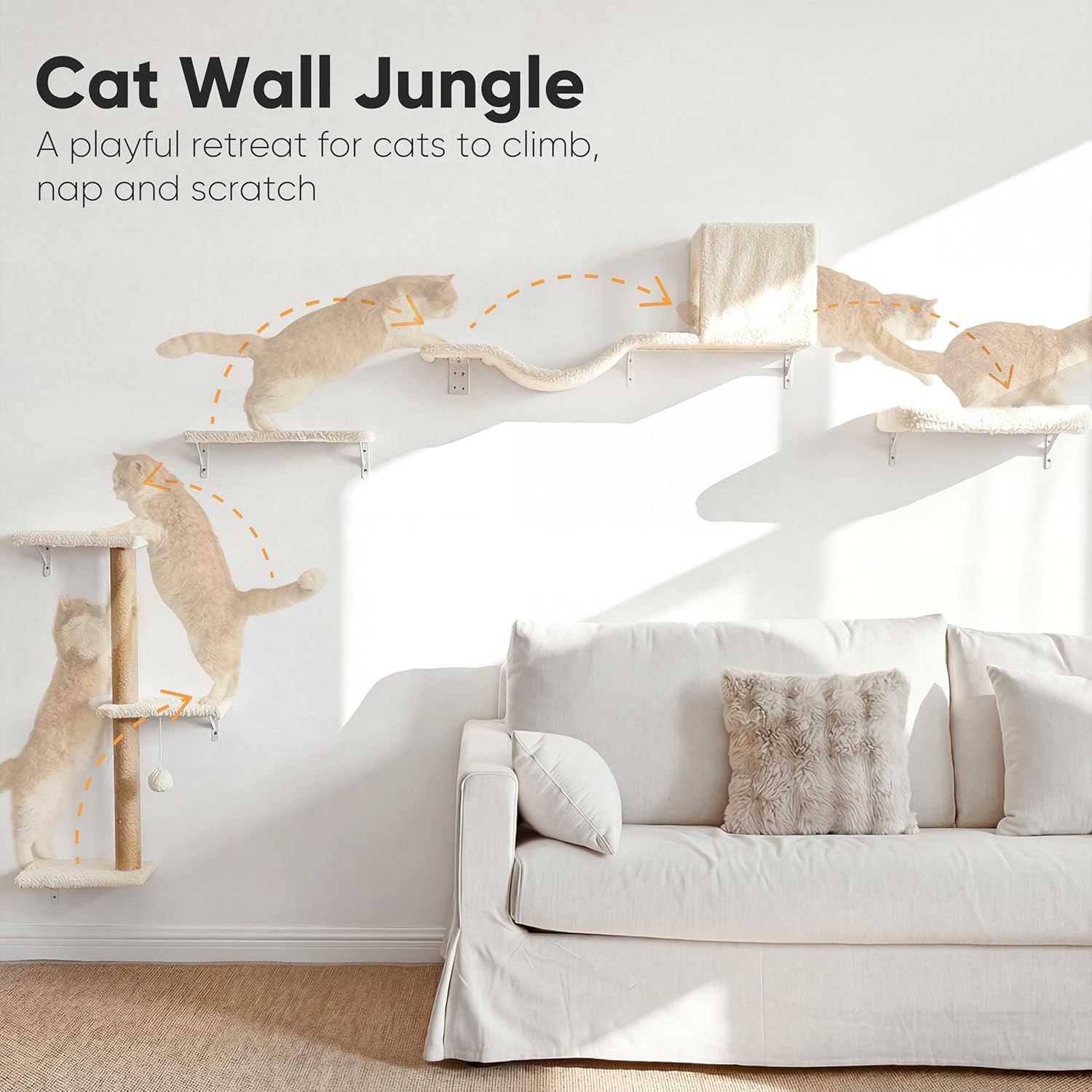
Cat wall shelves are exactly what the name suggests: shelves mounted on the wall, designed specifically for cats to climb, perch, and survey their territory from above. Unlike a freestanding cat tree — those carpeted towers you’ve seen in every pet store — wall-mounted shelves attach directly to your wall studs or drywall anchors and become a permanent feature of the room. For cats, vertical space (height they can actually access and move through) is a welfare essential, not a luxury: International Cat Care’s guidance on feline environmental needs identifies elevated perches as a core component of a stress-reducing home. For you, the difference between a $25 floating shelf with a sisal pad hot-glued on and a $180 walnut-finish perch from a design-forward brand is the difference between an eyesore you tolerate and something guests assume you chose on purpose. This guide will help you figure out which end of that spectrum makes sense for your walls, your cat, and your room.
Why “Design Integration” Is the Right Frame — and What It Actually Means
Most cat furniture is designed to appeal to the cat first and the room second — or third, or not at all. That’s a reasonable priority if you have a dedicated cat room. But if your shelves are going into a living room, bedroom, or open-plan space, they’re competing with everything else on those walls. Apartment Therapy’s coverage of cat wall installations consistently points out that the most successful setups treat the shelving as a gallery-wall decision: you’re thinking about sightlines, negative space, and how the piece reads from across the room.
Design integration, practically speaking, means four things:
Finish continuity. The shelf material should belong to the same visual family as your existing furniture. A powder-coated black steel bracket reads naturally in an industrial or mid-century room. Natural white oak sits well in Scandinavian interiors. If you have warm walnut floors and a linen sofa, a carpet-wrapped wooden box is a category error — not because carpet is wrong, but because the material language is wrong.
Scale and proportion. A shelf that’s 10 inches deep works for a small cat or a perch-only use. If you want your cat to comfortably lie flat (roughly 12–16 inches of depth for an average adult cat), the shelf needs to reflect that — and a deeper shelf is a more visually significant element, so its finish matters more.
Structural honesty. Brackets, hardware, and mounting plates that are visible should look intentional. Brands in the $150–$400 range (MiaCara, Tuft + Paw, Hepper) typically design the mounting hardware as part of the aesthetic. Budget options often expose whatever generic L-bracket came in the box — fine if it’s hidden, a problem if it’s the first thing you see.
Transition logic. A single floating perch looks decorative. A connected pathway — two to five shelves at ascending heights with a logical cat-travel route — can look architectural or chaotic depending on layout discipline. Modern Cat’s editorial coverage of cat wall systems regularly emphasizes planning the full route before buying any individual piece.
The Tradeoff Matrix: Budget, Mid-Range, and Designer Tiers
Here’s where the decision gets concrete. The market in 2026 breaks into three meaningful tiers, and they don’t just differ in price — they differ in what problem they solve best.
By the numbers — typical spec ranges by tier:
| Tier | Price range | Typical depth | Weight rating | Cover/pad washability |
|---|---|---|---|---|
| Entry | $15–$60 | 8–10 in | 25–40 lb (claimed) | Removable, machine wash |
| Mid-range | $65–$180 | 10–14 in | 40–65 lb (rated) | Varies — check specs |
| Designer | $180–$500+ | 12–18 in | 50–100 lb (rated) | Often dry-clean only |
Weight ratings above are drawn from published manufacturer specifications across common brands in each tier; always verify the specific product you’re purchasing.
Entry tier ($15–$60): The honest use case here is a secondary perch in a lower-traffic room, a first experiment before committing wall space, or a multi-cat household that needs volume. Owners in aggregated reviews consistently report that the surface materials — typically MDF board with thin veneer or PVC wrap — degrade faster than the mounting hardware fails. The shelf itself usually holds. The finish usually doesn’t. If washability is your priority, many entry options include removable fleece pads that machine-wash well, which is a real functional win the mid-range doesn’t always match.
Mid-range ($65–$180): This is where most design-conscious intermediate buyers land, and for good reason. Brands like Catastrophic Creations, CatastrophiCreations (the handmade market variant), and several private-label options offer solid wood construction, visible-grain finishes, and carpet or sisal surfaces that hold up through two to three years of daily use, based on long-run owner reviews. The mounting systems at this tier are generally more serious — lag bolts into studs rather than toggle anchors — which matters for multi-cat households where two cats may simultaneously leap to the same shelf.
The tradeoff at mid-range: fewer finish options, and the hardware aesthetic is functional rather than designed. You’re buying durability and material quality, not a furniture object.
Designer tier ($180–$500+): MiaCara, Tuft + Paw, and Lords & Labradors dominate editorial coverage in this space, and their differentiator is exactly what it sounds like — the objects are designed as furniture first. Wirecutter’s coverage of cat shelves and trees notes that the premium segment has matured significantly, with solid hardwood, powder-coated steel, and wool or bouclé surface materials now available in pieces that photograph indistinguishably from human furniture. The tradeoff: surface materials at this tier are often not machine-washable. Wool bouclé requires spot-cleaning or professional cleaning. If you have a cat with litter-tracking issues or a senior cat prone to accidents, a $300 shelf with a dry-clean-only surface is a liability, not a luxury.
Mounting: The Variable That Overrides Everything Else
You can buy the most beautiful walnut shelf in the world and have it fail if the mounting is wrong. This is the part buyers most commonly underestimate, and it’s worth slowing down here.
Stud mounting vs. drywall anchors. Studs (the vertical wooden beams inside your wall, typically spaced 16 inches apart) are the correct answer for any shelf that will bear a cat’s weight repeatedly. A 12-pound cat landing from a jump generates several times its static weight in impact force. Cornell University’s veterinary guidance on indoor enrichment doesn’t specify shelf hardware, but their framing of vertical territory as a daily-use necessity underscores why temporary or under-spec’d mounting is a real risk — not just a warranty issue.
Drywall anchors — the expanding plastic or metal fasteners used when a stud isn’t where you need it — are not all equal. Toggle bolts (the kind with a folding metal wing that spreads behind the drywall) are rated for significantly higher loads than standard plastic expansion anchors. If you can’t hit a stud, toggle bolts are the minimum for a cat shelf; confirm your wall’s drywall thickness first (most residential drywall is ½ inch, some older construction is ⅝ inch).
The layout planning step most buyers skip. Before purchasing, photograph your wall, note stud locations with a stud finder, and sketch a rough path at two height intervals: a lower landing shelf (roughly 36–48 inches from the floor) and an upper perch (60–72 inches). Owners who plan the route first consistently report higher satisfaction in long-run reviews — not because the individual shelves are better, but because the cat actually uses a connected system versus ignoring isolated perches.
Weight capacity honesty. Manufacturer weight ratings are typically stated for static load — a cat sitting still. Real use involves dynamic loading (jumping, landing, two cats at once). As a working rule: treat the listed weight capacity as a floor, not a ceiling. If your cat is 14 pounds, don’t buy a shelf rated for 15 pounds and call it safe. The mid-range and designer tiers consistently offer more conservatively spec’d hardware; entry-tier claims should be read skeptically.
Surface Materials: The Aesthetic-Function Tension
The surface your cat actually sits on is where design integration and cat behavior come into the most direct conflict.
Carpet and loop pile: Maximum traction for cats, especially seniors or cats with mobility issues. Nearly impossible to integrate into a design-forward room. Owners of designer shelves who also have older cats sometimes add aftermarket non-slip pads or small rugs — an imperfect solution but a practical one.
Sisal: The standard scratching-post material, woven from agave fiber. It integrates better than carpet — it reads as natural texture rather than utilitarian — and cats respond well to it. Sisal doesn’t vacuum easily but can be replaced on modular shelves; many mid-range brands sell sisal wraps separately. Over time, sisal grays and felts with claw use, which some rooms absorb better than others.
Solid wood (bare or oiled): The premium aesthetic choice. Woods like white oak, walnut, or ash look genuinely like furniture. The tradeoff is traction: smooth-finish wood can be slippery, especially for older cats or larger breeds. Some cats simply won’t use a wood perch without a pad. If you go bare wood, a thin, removable leather or wool pad addresses this — but now you’re managing a small pad’s washability and replacement.
Wool bouclé and upholstered surfaces: The most design-forward option and the least practical for high-traffic cat households. Owners in aggregated reviews consistently report that bouclé catches fur at a high rate and is difficult to lint-roll clean. For a single-cat household with a short-haired cat, the trade may be worth it. For a multi-cat home or a cat who sheds seasonally, this surface will work against you within months.
The Decision Rule: If X, Then Y
If your priority is longevity and you have multiple cats, buy mid-range solid wood with sisal or removable pad surfaces, mount into studs with lag hardware, and plan a five-point pathway. Spend on the system, not on any single premium piece.
If your priority is design integration in a high-visibility room and you have one or two cats, the designer tier justifies itself — but only if you match surface material to your cat’s actual behavior. A premium wool perch for a cat that ignores perches is a $300 sculpture. Verify your cat uses elevated surfaces before committing.
If you’re experimenting — new apartment, new cat, not sure of placement — start with one mid-range shelf on a stud, evaluate usage for 30 days, then plan the full pathway. The cost of getting the layout right the first time, rather than re-patching and remounting three times, is usually worth more than whatever you save by buying entry-tier pieces that you’ll replace.
The shelves that look like interior design aren’t necessarily the most expensive ones. They’re the ones where the material, the mounting, the surface, and the pathway were chosen as a coherent system — and where the decision matched both the cat’s actual habits and the room’s existing language.