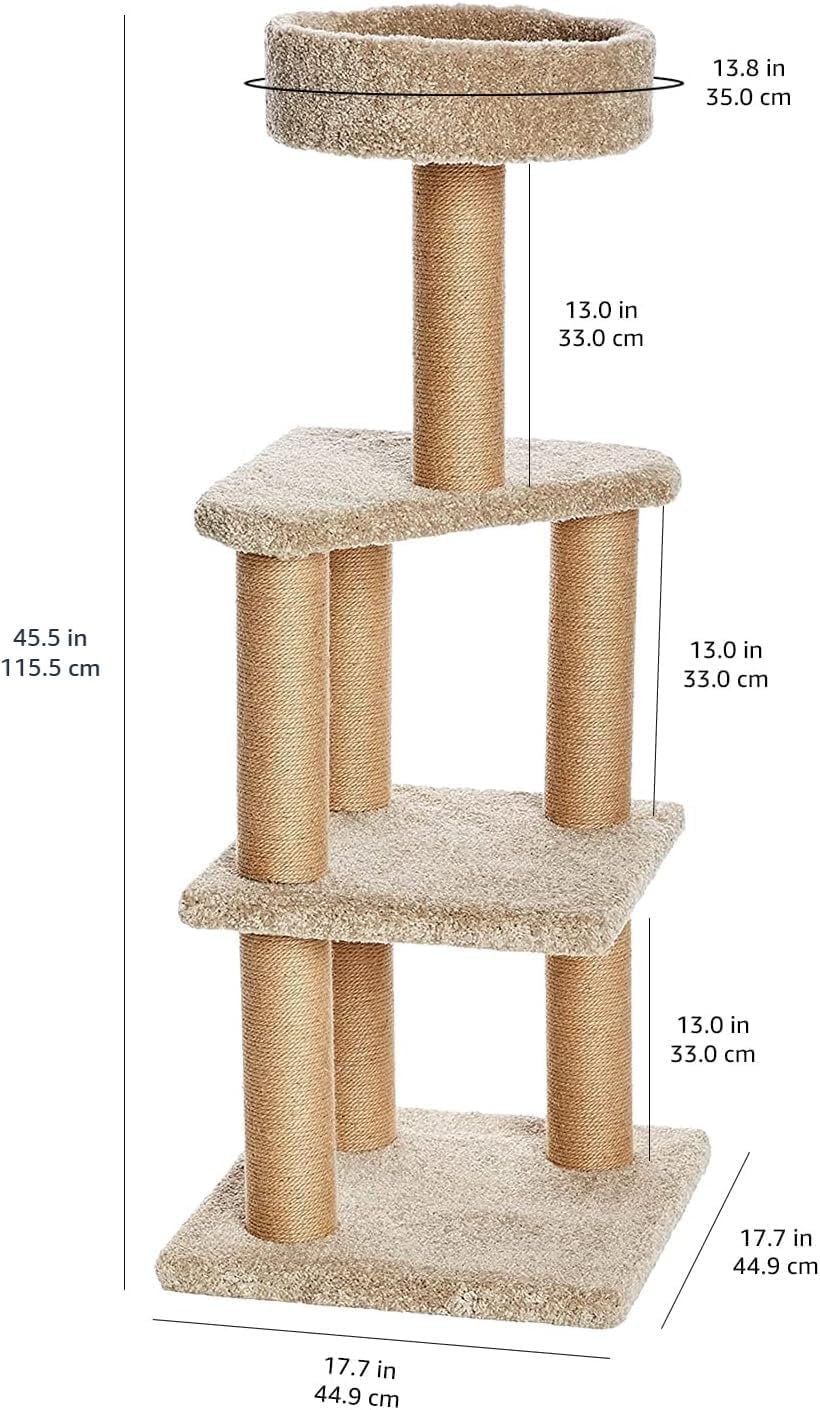
A cat tree is exactly what it sounds like: a multi-level climbing and lounging structure designed to give your cat vertical territory — somewhere to perch up high, scratch, and survey the room without destroying your couch. They range from a $19 cardboard scratcher on the floor to a $600 walnut-and-wool architectural piece. This guide lives at the $50-and-under end, which is where most first buys land and where the quality gap between a good pick and a bad one is shockingly wide. If you’ve already bought one cat tree and found yourself hiding it behind the couch two weeks later, you’re in the right place. We’ll walk through what actually matters at this price point — stability, cover material, visual footprint — and name the patterns that separate the picks worth keeping from the ones that deserve a return label.
| EDITOR'S PICK[Amazon Basics Cat Tree Tower](https://www.amazon.com/dp/B06X6J3L65?tag=greenflower20-20) -… | Mid-tier[Yaheetech 63in Large Cat Tree](https://www.amazon.com/dp/B09BCXFRHJ?tag=greenflower20-20) f… | Budget pick[TWDEPART Cat Tree Tower with Ca](https://www.amazon.com/dp/B0CNSWH1SQ?tag=greenflower20-20)… | |
|---|---|---|---|
| Height | 45.9" | 63" | — |
| Weight Capacity | — | 22 lbs | — |
| Hiding Cubby | — | ✓ | — |
| Price | $56.65 | $47.46 | $25.99 |
| See on Amazon → | See on Amazon → | See on Amazon → |
Why $50 Cat Trees Fail (And What “Fail” Actually Means)
Here’s the honest framing: almost every cat tree under $50 is made from particleboard (compressed wood chips and adhesive, not solid wood), wrapped in synthetic plush or sisal rope, and shipped in a flat box from an overseas manufacturer. That’s not automatically a problem. Particleboard can be structurally fine at this price — the question is how thick it is, how the joints are attached, and what the plush looks like after six months of claw contact and a few wipe-downs.
“Fail” at this tier means one of three things:
1. It tips. A cat tree that wobbles when your cat launches off the top platform is a safety hazard and a noise problem. Tipping is the single most-cited owner complaint across aggregated reviews on sub-$50 structures. The root cause is almost always a narrow, thin base relative to total height. Wirecutter’s cat tree research consistently names base-to-height ratio as the primary stability variable — a tree standing 40 inches tall needs a base of at least 16–18 inches in the widest dimension to feel planted.
2. It looks like a prop from a 1997 pet store. Beige or brown shag plush is the dominant visual problem. These trees don’t integrate with any living room style — not mid-century, not contemporary, not even “cozy farmhouse.” They read as clutter from the moment you assemble them, and that’s a livability problem even if your cat loves the thing.
3. The sisal disintegrates in three months. Cheap sisal wrapping is often applied with minimal adhesive, wrapped loosely, and made from lower-grade fiber. Cornell Feline Health Center’s guidance on scratching notes that cats need a surface with real resistance — one that “catches” their claws and allows full stretch. When the sisal shreds off a post in patches, the cat loses interest and redirects to your furniture anyway, which defeats the purpose entirely.
The Numbers That Actually Matter at This Price
Before getting to specific patterns, here’s a quick comparison frame:
| Spec | Red Flag | Acceptable | Strong for the Price |
|---|---|---|---|
| Base dimensions | Under 14” × 14” | 15–17” square | 18”+ or L-shaped weighted base |
| Post diameter | Under 3” | 3–3.5” | 4”+ |
| Sisal post height | Under 12” | 14–16” | 18”+ (allows full-body stretch) |
| Top platform weight rating | Not stated | 15–20 lbs | 25 lbs stated |
| Cover removal for washing | No | Partial | Full zip-off |
These aren’t arbitrary — they map directly to the failure modes described above. International Cat Care’s home environment guidance specifically recommends vertical scratching surfaces long enough for a cat to stretch fully upright, which for most domestic cats means a minimum of 16–18 inches of usable post height.
What Actually Looks Okay in a Living Room Under $50
The honest answer is: neutral tones, minimal silhouettes, and a clean plush finish (not shag). The color palette is the single biggest visual lever you have at this price. A dark gray or charcoal tree in a flat-weave synthetic disappears into a contemporary room much more gracefully than a beige shag version of the same structure. Apartment Therapy’s roundup of cat trees that don’t look like cat trees specifically calls out color neutrality and clean lines as the differentiating factor for budget options — noting that the structure’s silhouette matters less when the finish isn’t actively fighting the room.
Patterns worth looking for in this tier:
Gray or black flat-plush structures with 2–3 platforms. These are the workhorses. Look for a top perch that’s at least 12 inches in diameter (cats prefer a curled perch over a narrow ledge), a sisal post with at least 14 inches of wrap, and a base that visually anchors rather than floats. Owners of smaller cats (under 10 lbs) consistently report satisfaction with these; owners of larger cats (12 lbs+) more frequently note wobble and squeaking joints at the 3–6 month mark.
Corner-placement designs. A triangular or L-shaped footprint that tucks into a room corner does two things: it gains stability from the wall (less tipping risk) and it reduces visual intrusion in the room. If your layout allows a corner placement, prioritize this geometry over a freestanding centerpiece design.
Hammock-style hanging platforms over enclosed “condos.” The fabric condos — those little enclosed cubes — are a magnet for odor, difficult to clean, and often the first part to visually degrade. At this price, they’re usually made from the same plush as the rest of the structure but with worse ventilation. Hammock or open platform designs hold up better visually and practically over time. Wirecutter’s testing framework notes that enclosed compartments require more frequent cleaning intervention to stay odor-neutral.
The Ones That Do Embarrass Your Living Room — Red Flags to Walk Away From
Multicolor plush. Any cat tree that combines beige, brown, and burgundy plush — or worse, features a leopard-print top perch — is going to clash with virtually every intentional interior. This isn’t about being precious; it’s about the fact that you’re looking at this object every day. Owners report growing visual fatigue with these within the first month.
Height-to-base ratio failures. A tree marketed as “72-inch mega cat tower” for $39 is not a bargain — it’s a physics problem. The base will be under 15 inches, the posts will flex noticeably, and owners across aggregated reviews consistently describe the wobble as enough to make cats hesitant to use the upper platforms. Cats won’t consistently use a structure they don’t trust, per International Cat Care’s guidance on vertical space and perceived security.
Sisal that’s only on one 6-inch section. Some budget designs offer a token sisal wrap on a post that’s otherwise smooth or plush-wrapped. Cats need full scratch engagement — a 6-inch sisal band is performative, not functional. The cat will ignore it and go for your couch legs.
No assembly hardware specs listed. If the product listing doesn’t mention bolt-through hardware or bolt count, assume the structure relies primarily on press-fit dowels and friction — which means it wobbles out of square within weeks under active use. Look for listings that mention “bolt-through assembly” or show hardware bags in the product images.
The Decision Frame: If X, Then Y
Here’s where the intermediate buyer earns their confidence. You’ve now got the framework — here’s how to apply it as actual purchase logic.
If your cat is under 10 lbs and this is a scratcher-plus-perch for a smaller apartment: A 40–50 inch gray or charcoal flat-plush two-platform tree with an 18-inch sisal post and a 16-inch base is genuinely adequate. Spend under $45, accept the particleboard, and plan to replace it in 18–24 months. Owners in this use case consistently report satisfaction when expectations are calibrated correctly. Look for zip-off platform covers — the single most underrated feature in this tier.
If your cat is 12 lbs or larger, or you have two cats: Walk away from this price point for a primary climbing structure. The physics don’t work. A 12-lb cat landing from a 48-inch platform puts real dynamic load on joints that simply aren’t engineered for it at sub-$50 price points. Put the $50 toward a mid-range tree at $80–$120 with documented weight ratings and hardware-based assembly. You can still buy a sub-$50 ground-level scratcher post as a supplement.
If the goal is design integration first, function second: Your real options under $50 are a single-post sisal scratcher in natural rope finish, or a wall-mounted sisal panel — neither is technically a “cat tree,” but both earn the living room in a way that a full tower rarely does at this price. Apartment Therapy’s coverage of the “invisible cat furniture” trend confirms that wall-mounted and floor-pad scratchers are the most reliable budget-tier design solution for style-forward rooms.
If you’re furnishing a rescue foster room or utility space and appearance is irrelevant: Buy on stability and washability alone. Look for the widest base, the longest sisal post, and removable covers. Color doesn’t matter. This is the one context where those beige shag towers earn their place — they’re indestructible in the ways that matter for high-turnover use.
What This Tier Can’t Buy You (And When to Step Up)
Being honest about the ceiling matters as much as being honest about the floor. Under $50 gets you: a functional scratcher, one or two stable perches for a single small-to-medium cat, and a neutral visual presence if you choose carefully.
It does not get you: solid wood of any kind, washable machine-safe full covers as standard, a structure that holds visual crispness after 18 months, or meaningful engineering for cats over 12 lbs. PetMD’s behavioral guidance on vertical territory and enrichment notes that cats benefit most from tall, stable structures with multiple distinct zones — which is a design brief that honestly starts around $80–$120 to execute well.
The $50 tier is a legitimate starting point, not a permanent solution. Buy smart within it, calibrate your expectations honestly, and you’ll get 12–18 good months from the right pick before a step-up makes sense. That’s not a failure — that’s the tier doing its job.